
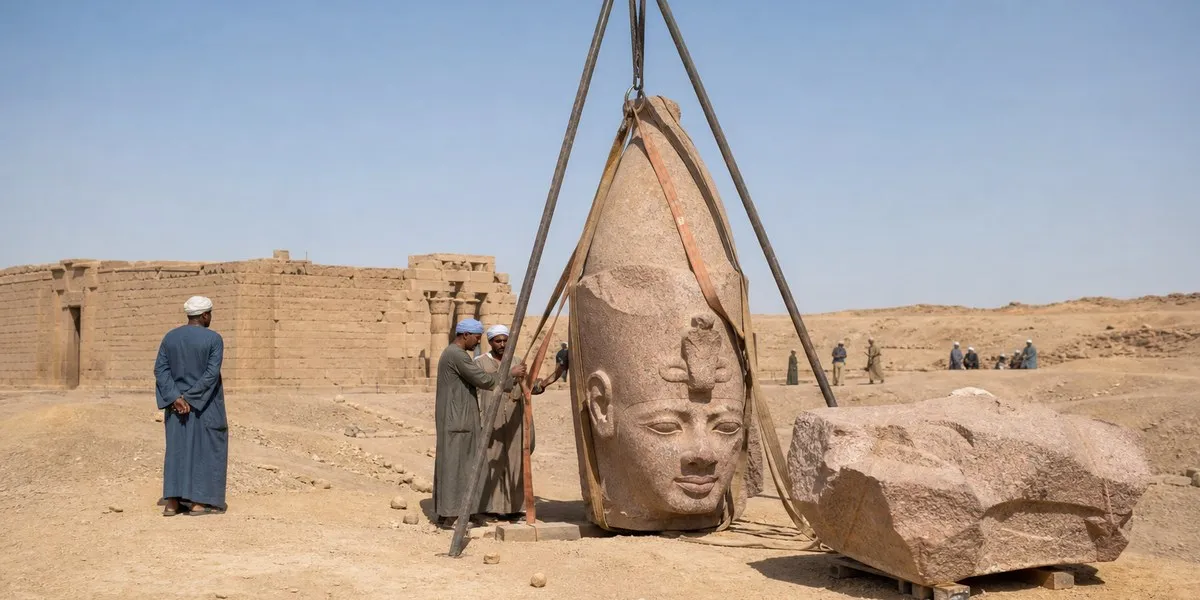
In the village of Behbeit el-Hagar, located in northern Egypt, an exciting archaeological discovery was made by local farmer Khaled el-Shahat. While tending to his land, he unearthed remnants of two colossal statues believed to be of Pharaoh Ramesses II. Upon notifying the Ministry of Tourism and Antiquities, experts were dispatched to investigate and excavate these significant artifacts.
Discovery of the Double Crowned Statue
The first statue uncovered is particularly striking, with estimates placing its original height at an impressive 8.5 meters. Today, primarily the statue’s head, which stands 1.6 meters tall, remains intact. This representation of Ramesses II is distinguished by the double crown symbolizing his rule over both Upper and Lower Egypt. In an exciting detail, part of the statue’s back pillar boasts a hieroglyphic inscription that features his Horus name, Hor-Ka-Nakht-Mery-Maat, meaning “Strong bull, beloved of truth.” This naming tradition reflects the connection between ancient pharaohs and Horus, the celestial deity.
Hieroglyphic Inscriptions and Historical Context
The second statue, which is about 2.4 meters tall, also likely portrays Ramesses II. This piece displays the pharaoh wearing a nemes headdress, a traditional striped headpiece associated with ancient Egyptian royalty. Alongside this statue, archaeologists uncovered a pink granite block adorned with hieroglyphic inscriptions that refer explicitly to Ramesses II and denote his stature as “king of Upper and Lower Egypt” as well as “son of Ra,” the revered sun god in ancient Egyptian mythology.
The site of Behbeit el-Hagar holds historical significance beyond this recent discovery. It is home to a temple dedicated to the goddess Isis. Notably, Egyptologist Mahmoud Emam from Cairo University highlighted prior findings of architectural fragments inscribed with Ramesses II’s name at the same location. The statues were found on the western side of the temple complex, underscoring the area’s rich cultural heritage. Ramesses II reigned from approximately 1279 to 1213 BCE and is renowned for initiating extensive construction projects throughout his empire, leaving a lasting legacy.
As the excavation continues, more insights and treasures may emerge, shedding light on the life and reign of one of ancient Egypt’s most significant rulers. Such discoveries not only enrich our understanding of Egypt’s storied past but also attract global interest in its archaeological endeavors.