
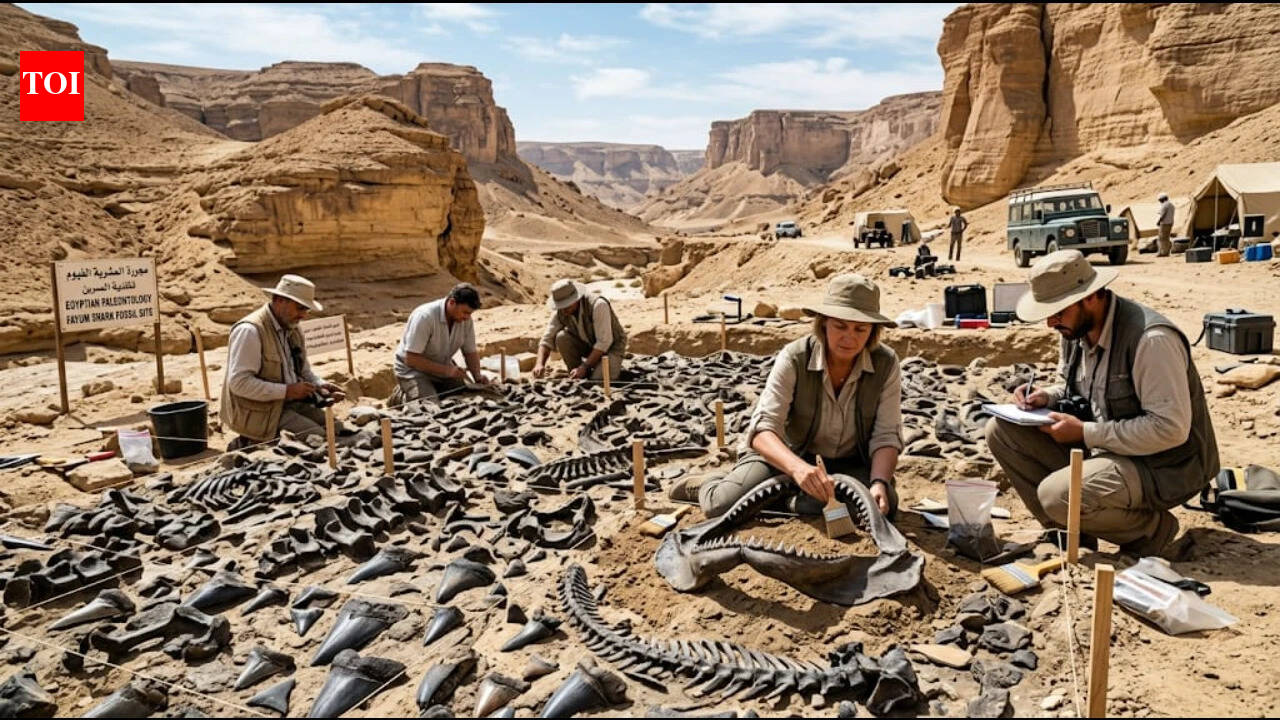
A remarkable discovery in Egypt’s Western Desert has unearthed fossilized shark teeth, revealing five extinct shark species from the Late Cretaceous period. The region, now a stark desert, was once a lush tropical sea teeming with marine life while dinosaurs roamed the Earth.
Insight into the Extinct Shark Species
The fossil finds were made at the Abu-Tartur Plateau, specifically in the phosphate-rich layers of the Duwi Formation. This geological formation dates back approximately 83.6 to 72.1 million years, during the Campanian stage of the Late Cretaceous. At that time, the climate was considerably warmer, with sea levels higher than today, allowing parts of North Africa to be submerged. The Duwi Formation preserves vital records of this ancient marine environment, characterized by rich phosphate deposits and an array of marine life. The teeth discovered are vital to understanding the diversity of predator species that once dominated these waters.
Fossil Teeth Point to Rich Biodiversity
While the researchers found only 14 isolated lamniform teeth during their excavation, the diversity indicated by these specimens is significant. Typically, shark teeth are more prevalent in the fossil record than complete skeletons because sharks continuously shed and replace their teeth throughout their lives. From the 14 teeth retrieved, the scientists classified five distinct extinct species: Cretalamna cf. C. maroccana, Scapanorhynchus cf. S. raphiodon, Serratolamna cf. S. serrata, Squalicorax bassanii, and Squalicorax pristodontus. Each species exhibited unique tooth shapes, indicating a varied diet and feeding strategies among these ancient sharks.
Significant Findings and Their Implications
Of particular interest is the potential first record of Scapanorhynchus cf. S. raphiodon in Africa. This underscores the importance of the discovery in expanding the geographical understanding of these prehistoric species. Although the identification of the fossils is not completely definitive, the findings point towards a rich marine ecosystem in ancient North Africa. The nuances of these identifiers, such as “cf.,” suggest that further research will be needed for clearer classifications, but they significantly enhance our understanding of the ancient shark populations.
A Window into Ancient Marine Environments
This discovery not only highlights the diversity of extinct sharks but also offers crucial insights into how ancient Egypt’s landscapes have changed over millions of years. The bones symbolize evidence of marine environments that no longer exist, hidden beneath Egypt’s current dry expanse. With the Duwi Formation marking the onset of fully marine conditions in this area, the shark teeth found help reconstruct not only the species that thrived but the ecological dynamics of that time. The phosphate layers were key to preserving these delicate remains, highlighting the geological processes that allowed such valuable fossils to survive through eons.
The importance of this discovery goes beyond the species identified. It enhances knowledge regarding the distribution and diversity of sharks during the Late Cretaceous while showcasing that ancient ecological communities were complex and diverse. Studies like these enrich our understanding of prehistoric life and its evolution, providing vital pieces to the puzzle of our planet’s history. As more findings emerge, they will continue to unveil the elaborate narratives of life that existed long before humanity walked the Earth.