
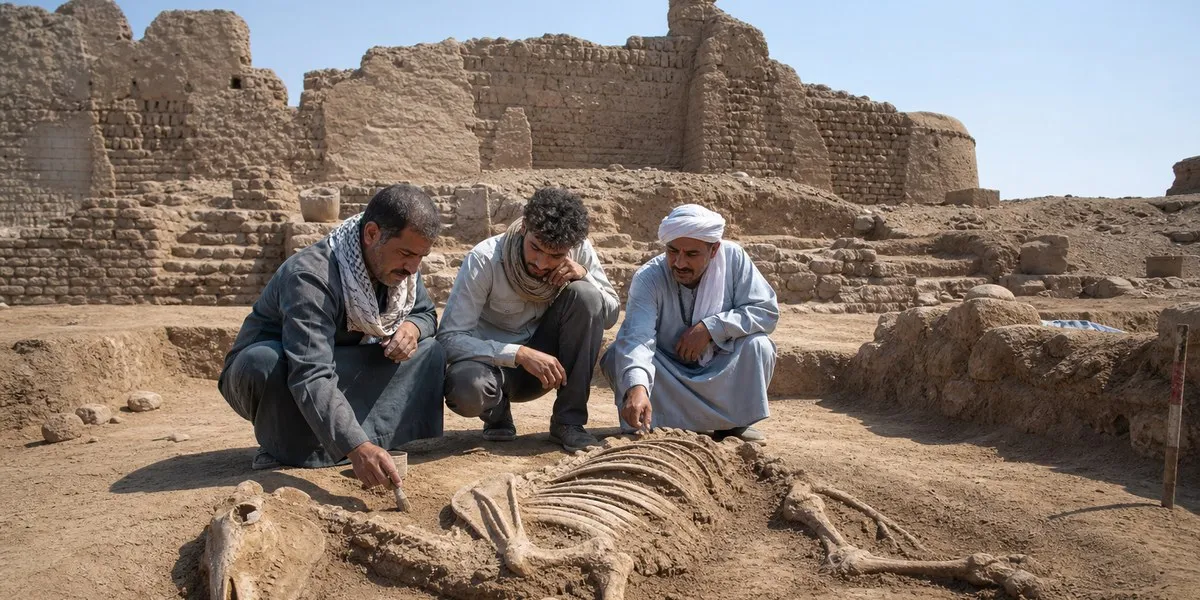
Archaeologists recently unearthed a 3,000-year-old horse burial at an ancient Egyptian fortress located in the western Nile Delta. The remains belong to a young male horse, likely of medium size, which might have served in a chariot or participated in military activities, as reported by Live Science. This significant find adds to the understanding of ancient Egyptian culture and military practices.
Details on the Horse and Harness
Close to the equine skeleton, researchers uncovered parts of a harness associated with chariot use. The Ministry of Tourism and Antiquities in Egypt suggests that the horse was likely given a ceremonial burial, implying its importance in the context of its time. This discovery occurred in the fortress at the Abqaa archaeological site, which dates back to the New Kingdom period (approximately 1550–1070 BC) and served as a defense mechanism against aggressive Libyan tribes from the west.
Lonneke Delpeut, an expert in ancient Egyptian horses from the University of Vienna, highlighted the rarity of horse remains, especially complete skeletons, from the Pharaonic era. She noted that while it is tempting to label the horse as a war horse, the concept of such a classification may not align clearly with ancient Egyptian culture. Nevertheless, she confirmed that the horse was indeed a chariot horse, and its respectful burial underscores its value to society.
Hieroglyphs and Other Discoveries
Alongside the horse remains, researchers also discovered a stone slab featuring a depiction of a captive Libyan, likely from the Meshwesh tribe, with whom Egypt frequently conflicted. The portrayal shows the captive in a submissive posture, hands bound behind his back, symbolizing defeat. This find not only illustrates the violent conflicts of the time but also provides insights into the socio-political relationships in ancient Egypt.
Additional artifacts were uncovered, including a hieroglyphic slab attributed to Pharaoh Ramses II, who ruled around 1279 to 1213 BC. Another slab references Pharaoh Merneptah, who succeeded Ramses and ruled approximately from 1213 to 1203 BC, comparing his might to the strength of Seth, the ancient deity associated with storms and deserts. These hieroglyphs are invaluable for understanding the lineage and power dynamics of ancient Egyptian leaders.
The intersection of these discoveries—both the horse burial and the hieroglyphic slabs—offers a richer narrative of life in ancient Egypt. They shed light on the military aspects, the social hierarchy, and the reverence placed on animals in society. As excavations continue at the Abqaa site, further findings may paint an even more detailed picture of this fascinating historical period.
In summary, the recently discovered horse burial and related artifacts not only enhance our understanding of ancient Egyptian life but also serve as vital links to its military and cultural heritage. The findings illustrate the complex interplays of power, reverence, and daily life in one of history’s most intriguing civilizations. As we unravel more layers of this rich past, we gain greater appreciation for Egypt’s enduring legacy.