
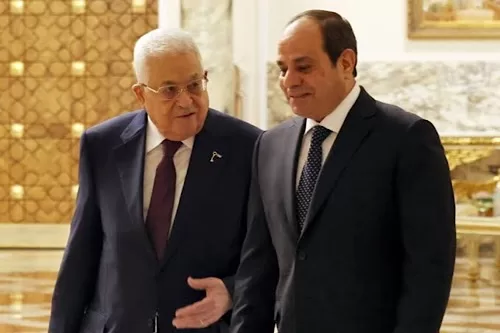
Palestinian President Mahmoud Abbas is currently in Egypt for discussions with President Abdel Fattah El-Sisi amid heightened tensions in the region. This meeting comes during a critical juncture for the Palestinian cause, as the ongoing conflict between the United States and Iran casts a long shadow. The agenda will likely center on Egypt’s responsibilities toward the Palestinian people, including urgent humanitarian aid and the prevention of forced displacement.
Supporting Palestinian Rights
Abbas and Sisi’s talks focus on Egypt’s determined stance against efforts to displace Palestinians and undermine their national identity. For over 1,074 days amidst Israel’s military actions in Gaza, Egypt has consistently stood against initiatives that threaten the Palestinian cause. This unwavering position is fueled by Cairo’s commitment to achieving a political resolution that ensures an independent Palestinian state with East Jerusalem as its capital.
Since the outset of the conflict, Egypt has ramped up diplomatic efforts to broker ceasefires and facilitate the influx of humanitarian aid. Sisi has made it clear—domestically and internationally—that no Palestinian displacement, nor the liquidation of the Palestinian cause, will be tolerated. During various summits, Sisi emphasized that safeguarding the rights of Palestinians is not merely a political strategy, but a matter of national security.
Efforts for a Ceasefire
Egypt has consistently advocated for peace through diplomatic channels, notably hosting various summits aimed at halting the violence. The Sharm el-Sheikh Peace Summit on October 13, 2025, highlighted this commitment with a signed document ensuring cooperation for a ceasefire and reconstruction in Gaza. The Cairo Peace Summit later that month reinforced this position, as Sisi articulated Egypt’s rejection of plans that aim to siphon Palestinians away from their land.
Throughout these discussions, Sisi has taken a firm stance against any military operations that result in potential mass displacement. His statements following meetings with international leaders have reinforced Egypt’s role as a mediator, focusing on a just resolution to the Palestinian issue rather than exacerbating an already volatile situation.
Humanitarian Assistance Initiatives
Beyond political advocacy, Egypt has also actively supported humanitarian efforts in Gaza. The “Zad al-Ezza — From Egypt to Gaza” initiative has sent 278 convoys loaded with crucial supplies like food, medical resources, and fuel. The Egyptian Red Crescent has been pivotal in this humanitarian outreach, mobilizing over 75,000 volunteers to deliver essential support.
Ultimately, Egypt’s actions reflect a strategic vision that recognizes the broader implications of displacement. Sisi has underscored that pushing Palestinians from their homeland is not simply a humanitarian issue; it threatens to erase the Palestinian identity and sovereignty altogether. In a region fraught with instability, Egypt’s steadfast approach prioritizes not only the immediate needs of Gaza but also the long-term stability of the region.
In conclusion, as the political machinery works to recalibrate the dynamics of Israeli-Palestinian relations, Egypt maintains a crucial role in safeguarding the rights and livelihood of the Palestinian people. The ongoing discussions between Abbas and Sisi are evidence of a comprehensive strategy aimed at fostering peace and ensuring that Palestinians remain anchored to their land.