
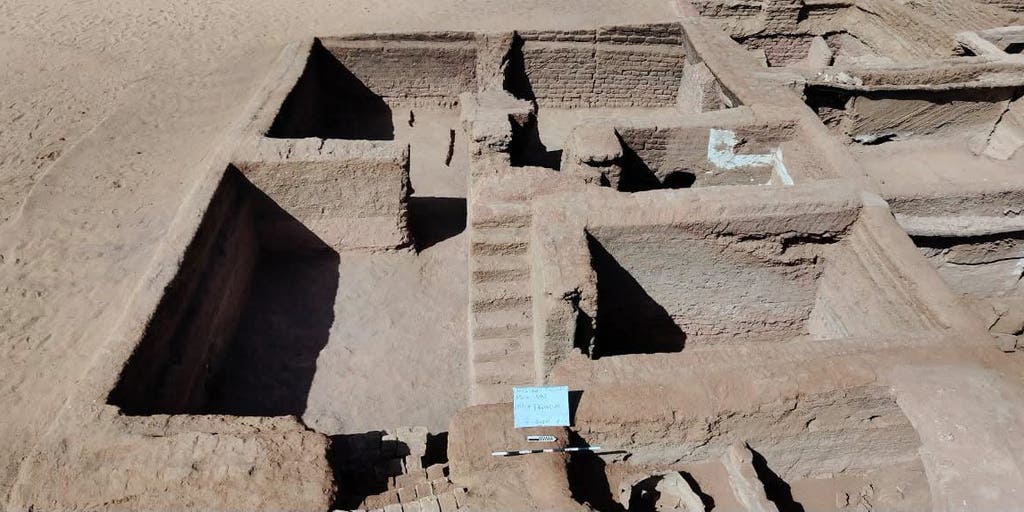
Recent archeological excavations in Egypt have unveiled significant insights into the Eastern Roman Empire, expanding our understanding of the region’s historical tapestry. The Ministry of Tourism and Antiquities has announced the discovery of a residential city dating back to the Byzantine Empire, showcasing rich architectural and cultural elements from this fascinating era.
Uncovering the Byzantine City
Archaeologists have been diligently excavating a site that appears to have been an organized urban settlement thriving during the Byzantine period. This city exhibits a layout characterized by a network of streets, open spaces, and a Basilica Church that overlooks one of the main avenues. Such urban planning indicates a sophisticated society that balanced functional living spaces with communal areas.
The findings suggest that this community was not just for survival but for a well-organized residential experience. Key features include two watchtowers, a dense fortress, and numerous houses equipped with amenities like kitchens and ovens. These elements point to a developed civilization where daily life flourished alongside security measures.
Alongside these major structures, researchers have also discovered an impressive assortment of bronze and gold coins, which feature images of Roman emperors alongside Latin and Christian symbols. The significance of these coins extends beyond currency—they serve as historical artifacts that offer insights into economy and faith during the Byzantine era.
Historical Context of the Eastern Roman Empire
Rome’s influence in Egypt predated the formation of the Byzantine Empire, but its establishment marked a transformative period. Under Emperor Constantine, who reigned from 306 to 337 AD, a “New Rome” was created in the city of Constantinople, now known as Istanbul, Turkey. This new capital was a melting pot of cultures, adopting Roman law, Christianity, and the Greek language to form a unique societal blend.
Constantine’s intention to populate the city swiftly involved granting citizenship and providing food rations, supported by an essential network of aqueducts for water supply. This innovative approach not only ensured that the city could sustain itself but also attracted and accommodated a diverse population.
The Byzantine civilization that flourished at Constantinople remained vibrant for over a thousand years. It became the epicenter of Eastern Christianity and culture before its fall to the Ottoman Empire in 1453. This transition marks a pivotal moment in history, highlighting the lasting impact of Byzantine architecture and governance on subsequent societies.
Continuing Discoveries and Their Implications
The ongoing exploration of antiquities in Egypt continues to unveil remarkable details about its historical narrative. Each excavation reveals new layers of cultural complexity, enriching our understanding of how ancient civilizations interacted and thrived.
As these discoveries unfold, they not only provide a glimpse into the architectural brilliance and daily life of the Byzantine Empire but also highlight Egypt’s role as a crossroads of cultures. This ongoing work underscores the importance of archaeological research in piecing together our shared past and offers valuable lessons about the interconnectivity of human societies throughout history.
Such findings not only resonate with historians but captivate anyone interested in the intricate tapestry of human experience across time and geography. As we learn more about civilizations like the Byzantine, we gain insights that continue to shape our understanding of culture, governance, and daily life in both ancient and modern contexts.