
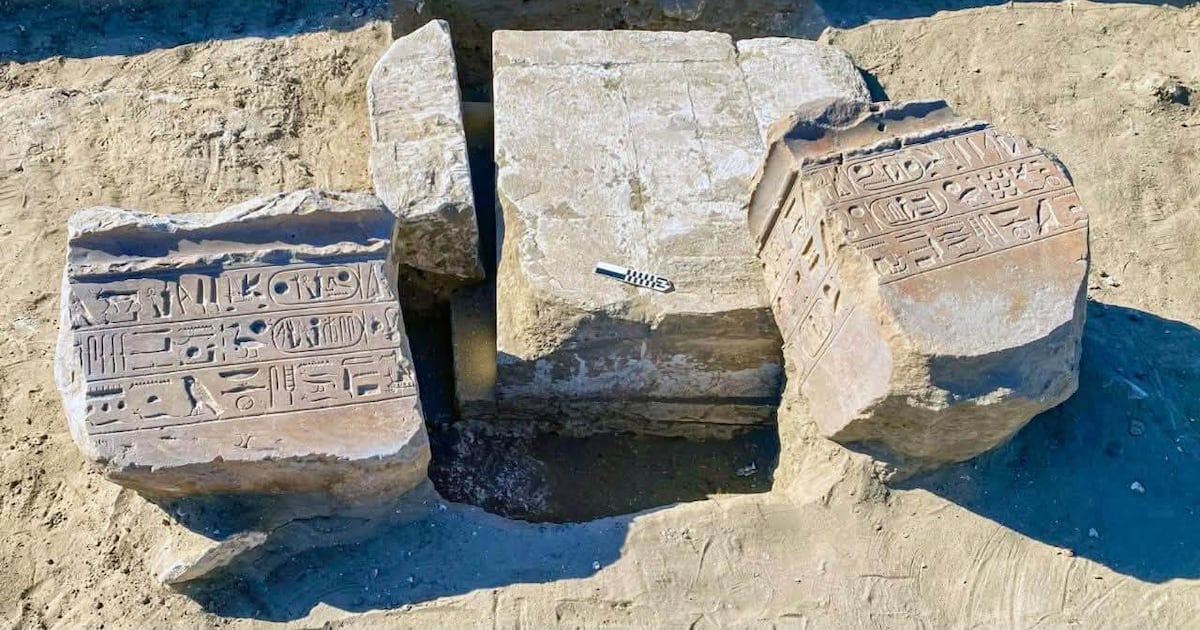
Archaeological findings in Egypt have shed light on the location of Masn, an ancient city referenced in historical texts over 3,000 years ago, which had remained elusive until now. The recent discovery of an inscription at Tell Abu Seify, situated in Qantara East near the Suez Canal, might confirm its identification, a reality that could reshape our understanding of ancient Egyptian geography and society.
Discovery of the Inscription
An Egyptian archaeological team uncovered a sandstone lintel inscribed with the name of the city during excavations at Tell Abu Seify. This significant find, which includes the names and titles of Ramses II, the pharaoh who reigned for over 60 years in the 13th century BC, enhances the historical connection between the site and the city of Masn. The inscription also references a restoration of a statue of Horus, noted as the “Lord of the City of Masn.” According to Hisham El Leithy, secretary general of Egypt’s Supreme Council of Antiquities, while this inscription strengthens the claim, further research and excavation are necessary to firmly establish the city’s identity.
Historical Context of Masn
Masn, often referred to as Mesen in academic circles, has been commonly associated with a local variant of the god Horus. Scholars have long debated whether Masn was a distinct settlement near Tjaru—Egypt’s primary fortress for routes across Sinai—or merely another name for Tjaru itself. The question has its roots in findings from 1887, when earlier remnants containing Ramses II’s name were discovered at Tell Abu Seify. Previous studies asserted that no occupation evidence from Ramses II’s era had been located at this site, prompting scholars to propose that the stones should have originated from nearby Tell Hebua, which is now recognized as Tjaru.
Implications of the Findings
The Ministry of Tourism and Antiquities has posited that the newly found inscription provides vital evidence supporting the theory connecting Tell Abu Seify to Masn. Confirming this identification would situate Masn along the Horus Military Road, a key route for trade and military endeavors linking Egypt to Sinai and ancient Canaan. This knowledge could significantly enhance archaeologists’ understanding of how ancient Egypt managed and protected its eastern territories. Further excavations have transformed prior perceptions of the site, revealing that a substantial mud-brick wall long thought to be part of a temple actually encircled the entire complex.
Continuing Excavations and Future Research
The team has also uncovered two stone roads connecting the fortified site to the temple, with one dating back to the Ptolemaic dynasty and the other from the Roman period. Inside the complex, evidence of organized spaces, such as storage and service rooms, along with the remains of a sanctuary, has been documented. Artifacts recovered include a statue of a military figure and fragments of various statues, underscoring the site’s historical richness. As this excavation continues, archaeologists hope to gather additional evidence that may definitively confirm whether Tell Abu Seify corresponds to the fabled city of Masn.
The invigorating discoveries remind us of the importance of continued archaeological efforts in grasping the nuances of ancient civilizations and their locations. Each find brings us closer to stitching together the complex tapestry of ancient Egyptian history.