
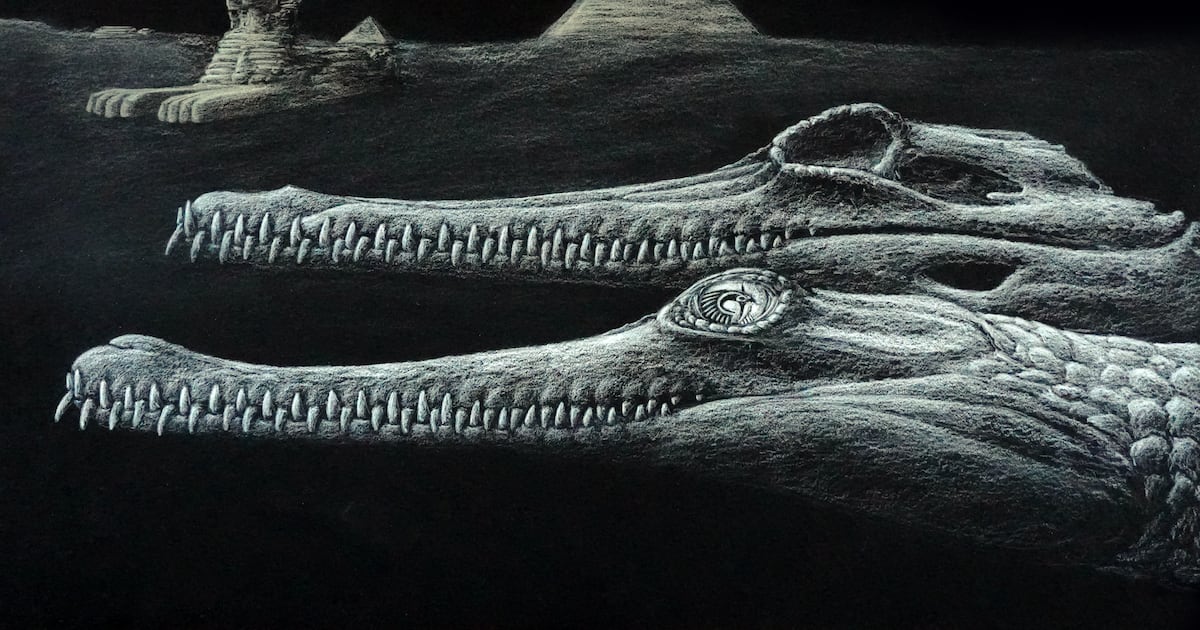
A significant discovery has emerged from a century-old fossil find within the 45-million-year-old Mokattam Formation in Egypt, revealing a previously unknown species of crocodile. This exciting development not only broadens our understanding of prehistoric life but also offers insights into the conditions of ancient ecosystems.
Discovery of Herugavialis cairensis
Scientists unearthed the skull of this new crocodile species while examining rocks used to construct the iconic Great Sphinx of Giza. Remarkably, the skull was mostly intact, save for the tip of the snout. Researchers have named this new species Herugavialis cairensis. Professor Philip Mannion from University College London, who co-led the research published in the Royal Society Open Science journal, noted that the naming pays homage to the Egyptian god Heru. This connection to the famed Sphinx adds a layer of historical intrigue to the scientific discovery.
Reclassification through Advances in Palaeontology
Initially, paleontologists believed this fossil belonged to the Tomistoma schlegelii species, a type of freshwater crocodile. However, recent advancements in analytical techniques allowed researchers to conduct a detailed CT scan, uncovering several distinct characteristics that differentiate Herugavialis from Tomistoma. This significant reclassification underscores the importance of modern technology in unraveling the complexities of ancient life.
Gavials: A Global Perspective
Herugavialis cairensis is part of a family of crocodiles known as gavials, which are predominantly found today in the Indian subcontinent and Southeast Asia. Intriguingly, the fossil record indicates that gavials once had a much broader distribution, thriving across the globe for more than 100 million years. This historical perspective sheds light on the evolutionary pathways that shape the biodiversity we see in present-day crocodilian species.
Crocodile Diversity in Ancient Egypt
During the time Herugavialis roamed the Earth, ancient Egypt was home to at least two other species of gavials alongside this newly identified crocodile. According to Dr. Paul Burke, a researcher at the Swedish Museum of Natural History and lead author of the study, the Mediterranean region experienced a rich biodiversity of crocodiles over the last 50 million years. However, this diversity was not stagnant; it fluctuated in response to changing global temperatures and sea levels, ultimately leading to the extinction of all crocodilian species in the region around six million years ago.
In summary, the discovery of Herugavialis cairensis not only enhances our understanding of ancient ecosystems but also emphasizes the dynamic nature of biodiversity through time. As we continue to unearth such fossils, we gain critical insights into evolutionary patterns that may influence current conservation strategies for crocodilians and other reptiles. The link between ancient species and modern creatures highlights the profound impact that historical climate change and habitat alterations have had on biodiversity throughout the ages.