
Stepping into Sha’ar HaShamayim Synagogue is a transformative experience, one that resonates deeply with the essence of Egyptian Jewish heritage. The name Sha’ar HaShamayim, meaning “The Gate of Heaven” in Hebrew, evokes a sense of divine connection. My journey to this sacred space began in the fall of 2021, as I arrived to celebrate Rosh Hashanah, the Jewish New Year, with the Drop of Milk Association.
Experiencing the Jewish New Year in Cairo
On that significant day, I arrived 20 minutes late, only to find that the main ceremony had already concluded due to Cairo’s notoriously congested traffic. Magda Haroun, the inspirational leader of the Drop of Milk Association, explained that in the absence of a rabbi, congregants engage in informal prayers. I was intrigued to hear the sound of the shofar echoing throughout the synagogue, signaling the start of the new year. Alongside the customary blessings of apples, honey, and pomegranate seeds, the event featured pastries from Simonds, a historic bakery that embodies the rich history of the Jewish community in Cairo.
Soon after this initial visit, I returned to the United States, unaware that Sha’ar HaShamayim would become a recurring part of my life.
Returning with Music and Connection
Exactly one year later, I found myself back at Sha’ar HaShamayim, this time with my cello. I was invited to share music for the New Year celebration, selecting “al-Dunya Ghinwa” (The World is a Song), performed by the renowned Egyptian Jewish singer Leila Mourad in the 1949 film “Ghazal al-Banāt.” Accompanied by Magda Haroun and her family, the event attracted an array of attendees—from members of the Drop of Milk Association to dignitaries from various embassies—each one present to honor Egypt’s rich cultural and religious tapestry.
The synagogue’s proximity to ‘Eish wa-Malḥ, a restaurant symbolizing shared bonds through food, further reinforced the communal spirit of the gathering. Standing among attendees, I could feel the warmth of connection, reminiscent of the historic harmony that once existed between the Jewish, Muslim, and Christian communities in Egypt.
A Journey of Exploration and Growth
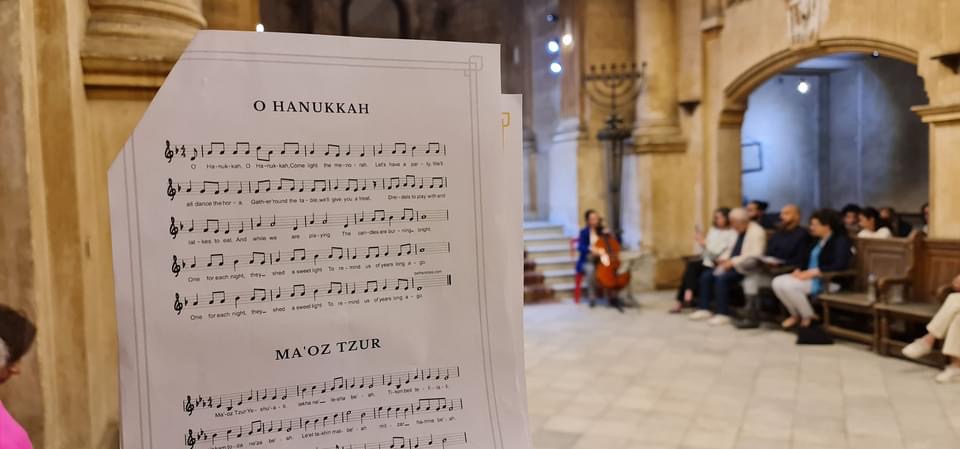
Throughout the year from 2022 to 2023, I participated in numerous events organized by the Drop of Milk Association. From lectures at Sha’ar HaShamayim to the unveiling of the renovated Basatin Karaite Jewish Cemetery, I engaged deeply with the subjects of cultural heritage and identity. I even had the opportunity to lead a singalong for Hanukkah, sharing the moment with artists like Lena Chamamyan and Yehya Khalil, two prominent figures in Egypt’s music scene.
In 2023, my husband Ahmed and I marked a historic occasion by performing at the al-Korba synagogue—celebrating Rosh Hashanah for the first time in 70 years at that location. We played well-loved songs from Jewish Egyptian musical icons, resonating not only with nostalgia but also with a sense of shared identity among the attendees.
Facing Challenges and Seeking Understanding
Despite the joy of these gatherings, the political climate surrounding us grew increasingly tense. The ongoing conflict in Gaza forced the Drop of Milk Association to halt celebrations, reflecting a profound sense of sorrow and loss. Under these circumstances, I began to notice a growing disparity in how people’s perceptions of Judaism and Zionism became intertwined. As someone who identifies as anti-Zionist, I recognized the importance of clarifying that many Jews stand opposed to Zionism, a distinction that often gets overlooked.
My studies at the Center for Arabic Studies Abroad (CASA) further enriched my understanding of this complex heritage. Through engaging discussions around films and literature focused on mixed Jewish, Muslim, and Christian identities, I deepened my commitment to learning and fostering conversations that bridge cultural divides.
Despite the halt of holiday observances, many individuals I met at the synagogue continue to convey warmth and solidarity, sharing greetings during significant occasions. The enduring spirit of ‘eish wa-malḥ remains alive among us, serving as a testament to the dynamic tapestry of Egyptian cultural heritage. The journey of connection, education, and mutual respect continues to unfold, reminding us of the shared history and hope for future harmony.