
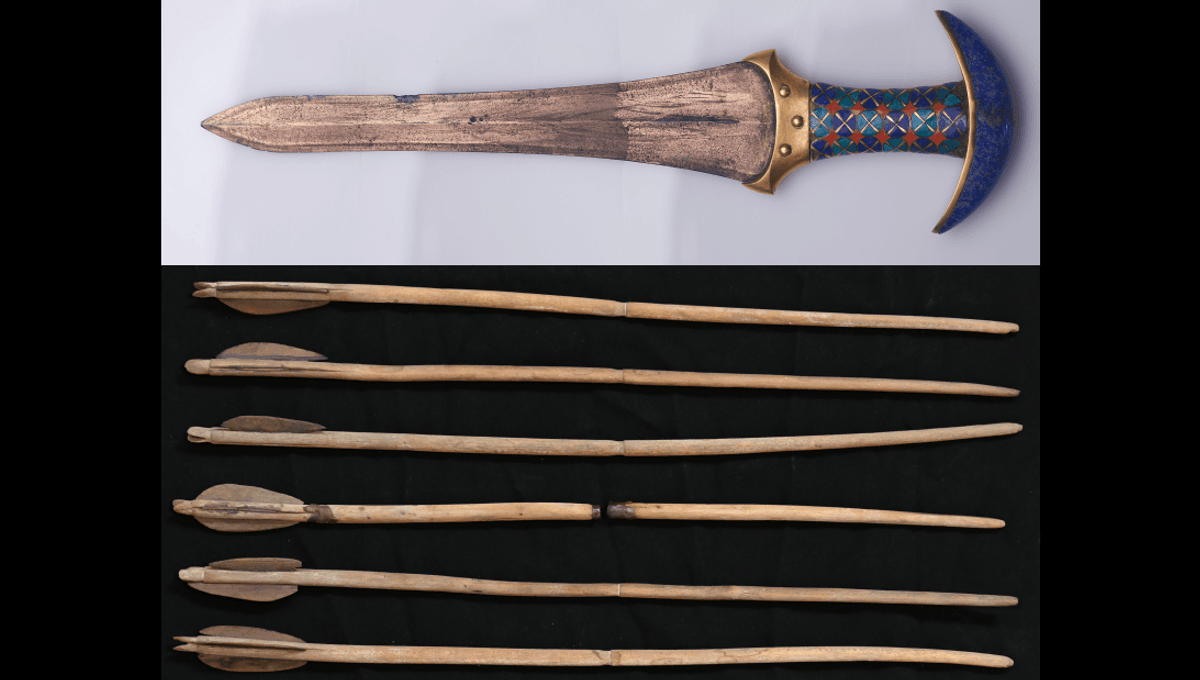
In the heart of Dahshur, Egypt, recent discoveries are reshaping our understanding of ancient gender roles. The remains of several female mummies, identified as ancient Egyptian princesses, offer a surprising narrative that diverges from historical assumptions about women’s involvement in martial activities.
Unearthing the Past
In the 1890s, archaeologists uncovered a funerary complex consisting of pyramids and tombs in Dahshur, revealing six mummies—five of which were female. This find included a shocking assortment of weapons, including daggers and arrows, typically associated with male burials. The presence of these artifacts raises intriguing questions: Were they merely ornamental grave goods, or did these princesses actively participate in the martial practices of their time?
Among the notable individuals within this burial site were four sisters—Princess Ita, Khenmet, Itaweret, and Sathathormeryt—who were interred in adjacent chambers. Additionally, a fifth princess, Noub-Hotep, was found in another part of Dahshur, possibly linked to King Hor. While these remains are approximately 3,800 years old and much of their soft tissue has perished, the remaining skeletal structures provide invaluable insights into their lives and challenges long-held beliefs regarding gender expectations in ancient Egypt.
Insights from Skeletal Analysis
Bioarchaeology offers a detailed examination of human remains within their archaeological context. The research focused on identifying how these women’s lifestyles influenced their skeletal formations. As Zeinab Hashesh from Beni Suef University explains, their findings indicate that the physical markers on the bones reflect high-intensity physical activities. Although there is no direct evidence that these princesses fought in battles, the wear and strain on their bones suggest they underwent rigorous physical training.
The skeletal analysis revealed striking “signatures” of physical exertion, particularly during archery and weapon handling. For instance, Noub-Hotep displayed an unmistakable “Archer’s Grip” evidenced by unique bone structures adapted for stabilizing a bow. Other princesses showcased muscle hypertrophy in their forearms, indicative of extensive bow-drawing, while Princess Ita exhibited robust muscle attachments related to weapon handling. This information signifies that their involvement with weapons was far more than a ceremonial duty.
Revising Historical Narratives
The discovery adds compelling evidence that these royal women were far from passive figures. Instead of adhering to a conventional image of ancient femininity, they were skilled warriors and athletes whose physical capabilities were on par with their male counterparts. Hashesh notes that such findings challenge long-standing biases in archaeology, which have often rendered athletic women invisible in the historical narrative. Traditionally, weapons in graves have been interpreted as markers of male status, while women have been associated solely with decorative items like jewelry.
The findings from Dahshur illustrate the potential for high social standing to expand or even redefine gender roles in elite contexts. This evidence encourages a rethinking of ancient burial customs and the motivations behind including weapons as grave goods for women. Not only were they buried with weapons, but there is now a considerable indication that they actively engaged in their use, thus challenging a century’s worth of assumptions regarding gender and martial activities in ancient Egypt.
As this groundbreaking study, published in “Frontiers in Environmental Archaeology,” demonstrates, the narrative of ancient Egypt is far richer than previously understood. The implications of these findings extend beyond mere archaeology; they invite deeper conversations about gender, power, and the complexities of life in the ancient world.