
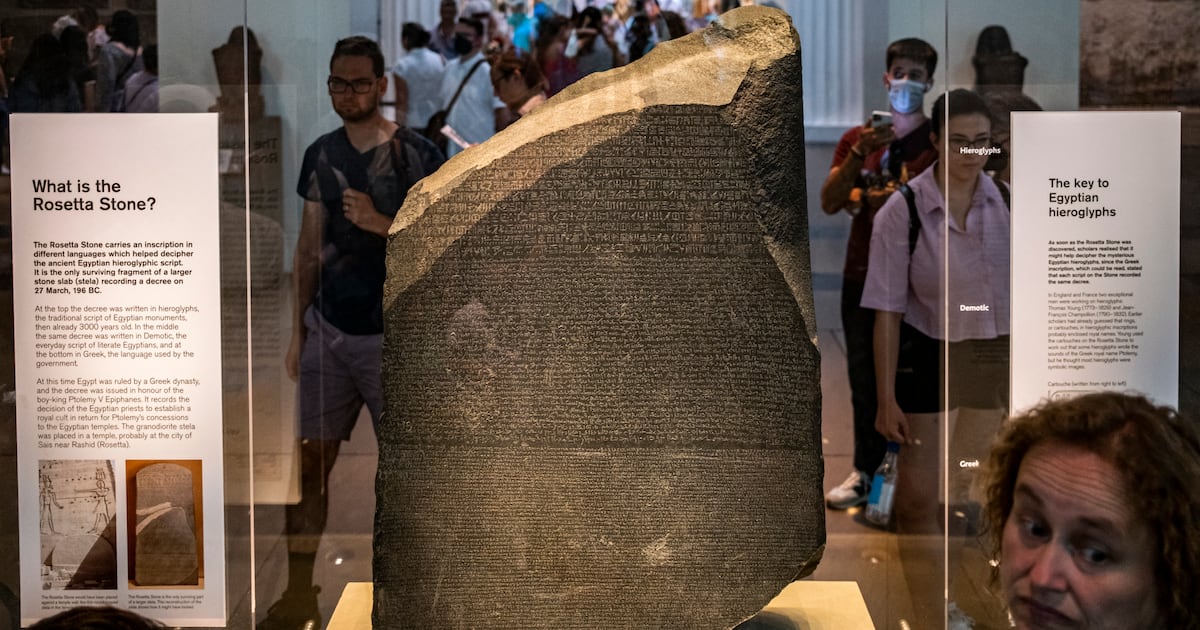
The Rosetta Stone is a significant artefact that continues to stir debate between Egypt and Britain more than 200 years after its discovery. As we commemorate the 227th anniversary of its finding near Rashid, Egypt, it’s crucial to understand the historical context surrounding this remarkable stone.
Historical Significance of the Rosetta Stone
Unearthed in 1799 during Napoleon Bonaparte’s Egyptian campaign, the Rosetta Stone has become an emblem of cultural heritage. Following the surrender of French forces in 1801, it was taken by the British and has been residing at the British Museum in London since 1802. The controversy surrounding its ownership escalated in recent years, with a movement led by Zahi Hawass, a former Egyptian antiquities minister, advocating for its return to Egypt. An online petition, initiated in 2022, has amassed approximately 350,000 signatures. Zahi Hawass plans to launch an international campaign once the petition reaches its goal of one million signatures.
Inscription Details and Linguistic Breakthroughs
What sets the Rosetta Stone apart is its unique inscription, which features two languages in three scripts. The upper section is inscribed in Egyptian hieroglyphs, primarily associated with temples and royal monuments. The middle part is written in Demotic, a cursive script used for everyday administrative tasks, while the Greek section appears at the bottom, reflecting the official language of the Ptolemaic court.
The stone encapsulates a decree from Egyptian priests lauding Ptolemy V, highlighting his contributions to the temples and tax reliefs. This politically motivated inscription is more a testament to the authority of the young king than a sacred text. The significance of the Rosetta Stone extends beyond its content; it served as a key to unlock the mysteries of ancient Egyptian hieroglyphs.
The Deciphering of Hieroglyphs
Decoding hieroglyphs had become increasingly difficult as knowledge faded over centuries, particularly after the closure of Egyptian temples. The breakthrough came in 1822, when French scholar Jean-François Champollion utilized the Greek inscription to make connections between the hieroglyphs and their phonetic equivalents. His expertise, particularly in Coptic—the most recent form of the Egyptian language—enabled him to crack the code, transforming the Rosetta Stone into a symbol of linguistic discovery.
Since then, the term “Rosetta Stone” has been metaphorically adopted in popular science to describe a complex puzzle or code.
The Ongoing Debate Over Ownership
The Rosetta Stone remains in London under contentious circumstances. Following the defeat of French forces at Alexandria in 1801, the artifact came into British possession and was later presented to the British Museum by King George III. Insignia on the stone read, “captured in Egypt by the British Army in 1801,” reinforcing the narrative of colonial acquisition.
While visitors can view the original stone for free at the British Museum, a replica is showcased at the Rashid National Museum in Egypt. The discourse regarding the stone’s rightful home continues, with proponents like Hawass advocating for its display at the newly established Grand Egyptian Museum in Giza, suggesting it belongs among the treasures of ancient Egypt. Meanwhile, others argue for its return to Rashid, the city whose name it bears. The debate highlights complex issues surrounding cultural heritage, national pride, and the ethics of artefact ownership that remain relevant today.