
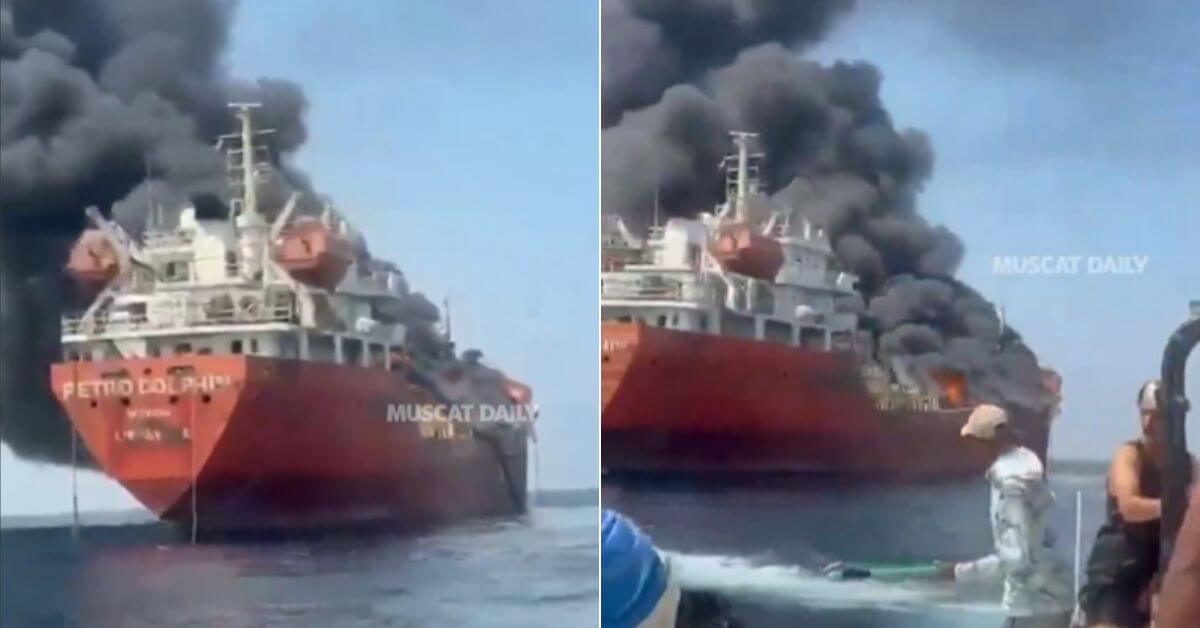
Three tankers faced attacks near Oman and the Strait of Hormuz over the recent weekend, heightening tensions in the region. Concurrently, U.S. forces took action against a cargo ship suspected of trying to breach a U.S. naval blockade aimed at Iranian ports. These incidents have raised concerns regarding maritime safety and geopolitical dynamics.
Details of the Recent Attacks
A drone strike affected a tanker near Sohar, Oman, leaving two Indian seafarers unaccounted for. The ongoing maritime conflict illustrates a worrying trend, as multiple vessels were targeted in the Strait of Hormuz, including a fire onboard an oil tanker whose cause remains undetermined. Iran’s Islamic Revolutionary Guard Corps (IRGC) suggested that one of the vessels struck a naval mine, intensifying suspicions and fears surrounding Iranian naval operations.
According to the UK Maritime Trade Operations (UKMTO), a vessel was hit by an unmanned aerial vehicle (UAV) on October 11. The damaged Nicaragua-flagged tanker was carrying a crew of 14 members, two of whom are now missing. Eyewitness accounts revealed significant smoke rising from the vessel, substantiating the severity of the situation. The IRGC had issued warnings just days prior, threatening “definitive” consequences for ships not authorized to traverse the Strait of Hormuz, thus escalating the maritime standoff.
Multiple Incidents in and Around the Strait of Hormuz
On October 11, another tanker was reported hit on its port side by an unidentified projectile, leading to damage but, thankfully, no casualties among the crew. This vessel, identified as the Angola Prosperity, a very large crude carrier (VLCC) operated by Sinokor, showcased the imminent danger seafarers in this busy shipping lane face. Similarly, the Marshall Islands-flagged Suezmax tanker Valthera experienced a separate attack, resulting in a fire onboard.
Amid these unsettling events, the IRGC Navy claimed that a supertanker caught fire after allegedly hitting an Iranian naval mine. The IRGC asserted that the vessel breached a designated high-risk area before the incident, although this claim remains unverified by independent sources.
U.S. Military Actions and Regional Implications
In a seemingly related series of events, U.S. forces targeted the Panama-flagged bulk carrier Ocean Molica, also known as the Arika Sun. Central Command (CENTCOM) indicated that the ship’s crew had defied multiple warnings and was attempting to escape the U.S. naval blockade. A U.S. fighter jet employed precision munitions to disable the vessel without inflicting harm on the crew, marking a significant escalation in military engagement in the area.
The U.S. blockade, revamped in mid-July, has already disabled four commercial vessels and diverted 135 ships, showcasing an aggressive posture towards any entities associated with Iranian operations. Despite these measures, initial reports indicate no direct connection between the U.S. strike and the recent tanker attacks, though Iran’s stern warnings have affected shipping activities in proximity to the Strait of Hormuz.
Maritime Security Concerns and Regional Responses
In light of these incidents, maritime security remains a top concern in the region. Reports on October 10 revealed that several shipmasters near Ras Al Khaimah in the United Arab Emirates had received advisories via radio, warning them to vacate their anchorages, although the source of these warnings remains unidentified. Furthermore, the UAE National Guard successfully rescued 22 individuals from an oil tanker in the Arabian Gulf after a fire erupted onboard, emphasizing the critical nature of maritime safety in these turbulent waters.
As these precarious situations unfold, the international maritime community must closely monitor developments in the vicinity of the Strait of Hormuz. Ensuring the safety of seafarers and the stability of maritime trade routes will likely continue to be a key focus as tensions evolve.