
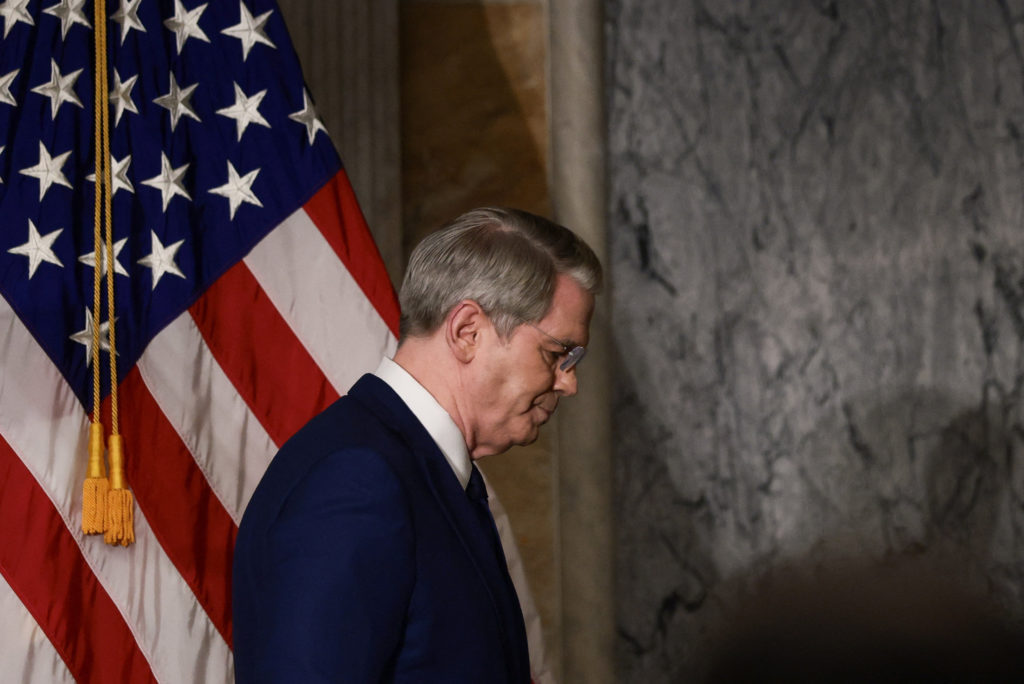
President Donald Trump’s administration is set to impose new sanctions on another bank this week, further escalating efforts to economically isolate Iran, according to U.S. Treasury Secretary Scott Bessent in a recent interview with The Associated Press. This action is part of a broader strategy to pressure Iran amidst ongoing hostilities between the two nations.
Escalating Economic Pressure on Iran
Secretary Bessent emphasized the seriousness of the sanctions, stating, “This is going to be financial violence if we have to.” His remarks underscored the administration’s determination to hold Iran accountable for its actions. Bessent, who is participating in the upcoming Group of 20 (G20) meetings in Asheville, North Carolina, plans to encourage international cooperation against Iran’s ongoing activities. He intends to meet individually with counterparts from both major and developing economies to reinforce this strategy.
With the conflict in the region marking six months, the Trump administration has shifted its focus from military strikes to economic pressure. Dubbed an “economic D-Day,” this approach seeks to impose substantial financial repercussions on Iran, which has already endured decades of stringent sanctions. While these measures are aimed at weakening Iran’s economic foundations, tensions have recently flared, leading to military strikes on Iranian positions in the Strait of Hormuz. This return to hostilities has raised concerns about the effectiveness of solely relying on sanctions.
The Challenge of Addressing Global Partners
Despite the aggressive tone of the sanctions, the administration faces significant challenges, particularly regarding Iran’s trading partners. Notably, China remains Iran’s largest trading partner and a major buyer of its oil exports. Secretary Bessent acknowledged the complexities of dealing with China, stating he would communicate with Chinese officials during the G20 meetings. He indicated that “all options are on the table” concerning sanctions against Beijing for its continued trade with Iran.
However, Bessent dismissed the notion that the administration is hesitant to confront China, labeling it a misleading portrayal. He asserted that both nations share common ground in wanting to ensure the reopening of the Strait of Hormuz and preventing Iran from advancing its nuclear capabilities. This highlights the intricate balancing act the U.S. must perform as it navigates its relationships with allies and trading partners while applying pressure on Iran.
Implications for Financial Institutions
The U.S. Treasury’s initial action in this renewed campaign against Iran was a proposed rulemaking that could cut off the Emirati branches of Banque Misr, Egypt’s second-largest bank, from access to the U.S. financial system. Although this step signals a move toward deeper sanctions, the administration has refrained from imposing penalties on the Egyptian bank itself. This decision might indicate a reluctance to act against key trading partners—including China and India—that do business with Iran.
The Trump administration’s approach raises serious questions about the overall effectiveness of sanctions. While they have long been a favored tool of American foreign policy, their impact is often blunted when allies continue to engage economically with the targeted nation. The mixed signals regarding sanctions may complicate the U.S.’s ability to form a cohesive strategy that genuinely isolates Iran economically.
As the situation develops, it remains to be seen whether these financial measures and diplomatic efforts will achieve their intended outcomes or further complicate an already volatile geopolitical landscape. The outcome will hinge not only on the U.S. administration’s resolve but also on the reactions of those nations that continue to engage with Iran.