
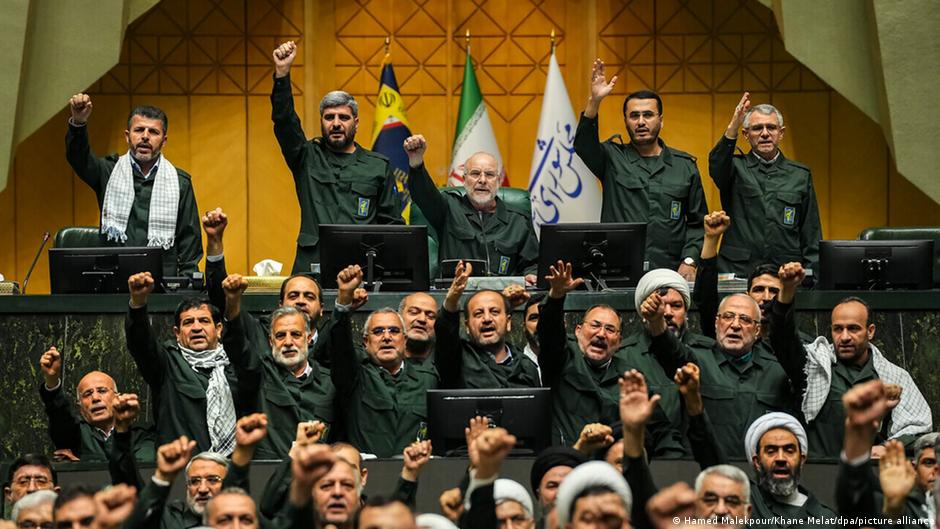
In the wake of Iran’s revered Supreme Leader Ayatollah Ali Khamenei’s death, various leaders and media outlets in the Islamic Republic have intensified their calls for retaliation. The shift in tone reflects a determination to position the regime as resolute, despite facing significant military and political challenges.
Parliament’s Ultimatum
On July 14, during the first in-person session of the Iranian parliament since the onset of the conflict, lawmakers displayed red flags advocating for revenge. Reports indicate that over 180 of the 290 parliamentarians supported demands for retribution. This fervor for retaliation is not confined to the halls of power; it resonates throughout state-controlled media channels. The conservative daily Hamshahri recently released what it dubbed a “wanted list,” featuring notable Western politicians and military leaders, including high-ranking officials from the United States and Germany.
Psychological Warfare and Deterrence
Legal scholar and human rights analyst Moein Khazaeli stressed that these threats should not merely be perceived as political posturing. He asserts that the Iranian government has multiple objectives that extend beyond mere bravado, describing the rhetoric as a blend of psychological warfare and a deterrent strategy. According to him, the regime aims to maintain an image of military strength and operational capability amid evident vulnerabilities. Additionally, the troubling history of the Islamic Republic’s overseas operations suggests that such threats, while arguably exaggerated, cannot be entirely dismissed.
The Hamshahri newspaper, affiliated with conservative elements within the Iranian political sphere, has consistently opposed negotiations with the U.S. and has a close relationship with the Islamic Revolutionary Guard Corps (IRGC), Iran’s most powerful military faction.
Political Instrumentalization of Mourning
Political activist Reza Alijani argues that the mourning ceremonies for Khamenei also had political motives. He believes that these events were strategically employed to reinforce loyalty to the regime, deflect attention from military failures, and legitimize ongoing conflict under the guise of vengeance. Right after Khamenei’s funeral, the new supreme leader, Mojtaba Khamenei, reiterated this message, focusing on revenge rather than healing or rebuilding. A statement released shortly after the mourning period asserted a commitment to avenge not only the slain leader but all martyrs of recent conflicts, emphasizing a narrative of enduring hostility.
Targeting Domestic and International Audiences
Khazaeli notes that the primary audience for these threats includes both domestic supporters and international adversaries. For years, the Islamic Republic has responded to setbacks with boosted aggression to project a facade of resilience. This narrative, underpinned by state propaganda, remains credible for certain segments of its support base.
Additionally, the regime seems to be sending a clear message to external opponents, particularly Iranian journalists, political dissidents, and human rights advocates abroad. This dual-focus strategy became evident during the recent death of U.S. Senator Lindsey Graham, a vocal supporter of aggressive policies against Iran. State media and pro-government channels reacted with notable satisfaction, further illustrating the regime’s intent to underscore its adversities through provocative rhetoric.
As political tensions rise, the rhetoric surrounding Iran’s leadership also serves to reinforce the current regime’s grip on power while simultaneously portraying a united front against external threats. The ongoing discourse is not just a matter of posturing; it has tangible implications for both domestic stability and international relations.