
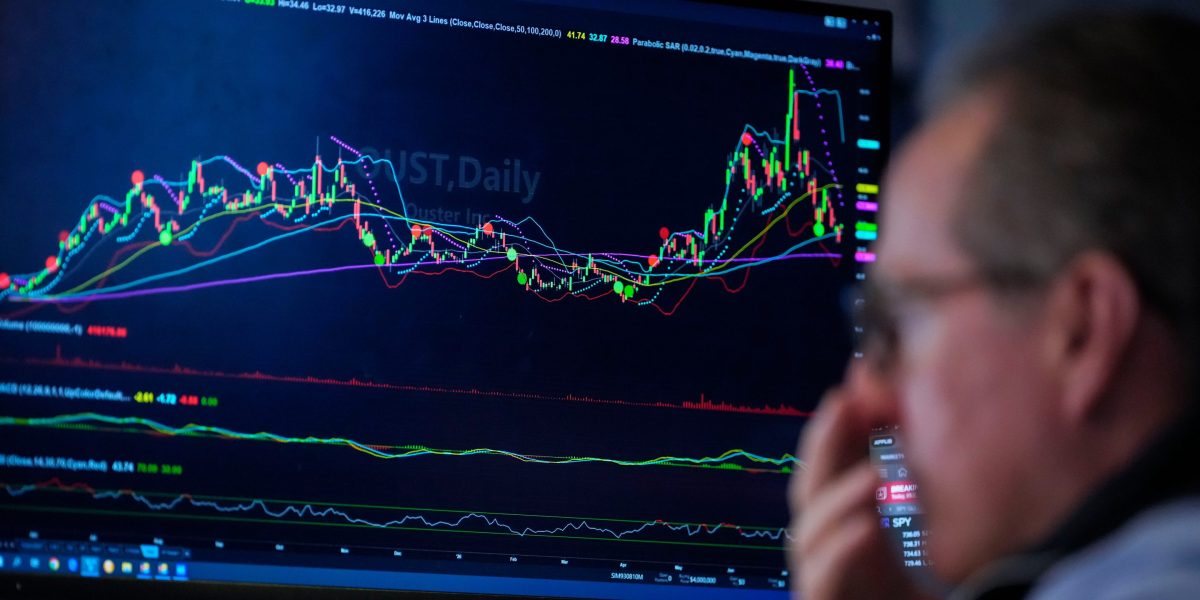
Global stock markets experienced a positive trend on Tuesday, buoyed by a rally in Wall Street stock prices and a decrease in oil prices. Investors reacted to various economic signals, with many still assessing the effects of recent currency interventions in Japan and the United States.
Market Reactions in Europe
In Europe, major indices showed gains during early trading hours. France’s CAC 40 index increased by 0.3%, reaching 8,643.50. Germany’s DAX surged by 0.9%, marking a new high at 26,232.04. The British FTSE 100 also saw an uptick of nearly 0.4%, standing at 10,897.75 at close. The consistent upward movement in these indices showcases a favorable sentiment among investors as they react to global economic developments.
U.S. markets were also set to continue this upward momentum. Dow futures indicated a slight rise of 0.1%, positioned at 53,409.00, while S&P 500 futures climbed by 0.2% to reach 7,644.00. This suggests that Wall Street’s optimism may carry over into the trading day, influencing investor sentiment in other regions as well.
The Impact of Currency Interventions
In Asia, Japan’s Nikkei 225 index experienced a gain of 0.3%, closing at 63,957.53. This rise coincided with the U.S. dollar’s increase against the Japanese yen, pushing the dollar to 157.80 from 157.18 yen. Despite this momentary increase, the yen’s value remains a point of concern, as it had recently fallen to nearly a 40-year low before regulatory measures were taken to stabilize it. Analysts are skeptical about the long-term effectiveness of these currency interventions, arguing that they do not resolve the underlying economic issues driving currency fluctuations, such as inflation and interest rates.
Research from BMI, a division of Fitch Solutions, suggested that a coordinated intervention led by the U.S. has greater market implications than Japan acting independently. The anticipation of further measures may act as a deterrent for speculators but could be limited in scope. The complexity of global economics requires more than a simple intervention to create lasting stability in currency values.
Sector Performance and Energy Prices
In South Korea, the Kospi index saw a robust increase of 1.6%, finishing at 6,358.95. Australia’s S&P/ASX 200 rose by 1.4% to 9,145.80. Conversely, Hong Kong’s Hang Seng index dipped by 0.6%, landing at 25,852.92, while the Shanghai Composite experienced a slight increase of 0.3%, closing at 3,822.28.
Oil markets also reflected shifting sentiments, with U.S. crude oil prices increasing by 15 cents, reaching $80.49 per barrel. Brent crude, the international benchmark, rose by 98 cents to $84.75 per barrel. This follow-up comes after a significant drop of over 5% the previous day, prompted by developments in U.S.-Iran relations, particularly following President Donald Trump’s decision to refrain from new military actions.
Overall, the dynamics of currency values and energy prices are intricately linked to broader market trends, influencing investor strategies and market behaviors across the globe. As these economic factors evolve, their ramifications will continue to shape market activity and investor sentiment moving forward.