
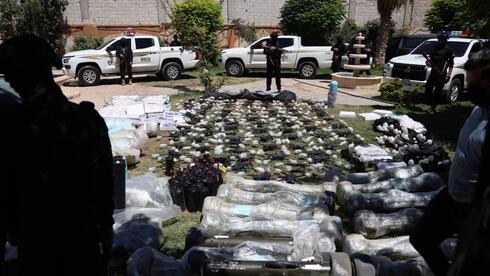
Syria’s Interior Ministry announced on Tuesday that it successfully thwarted an alleged attempt to smuggle advanced arms through its territory, purportedly destined for Hezbollah. This declaration, which branded the Lebanese group as a “terrorist militia,” signals a notable shift in the rhetoric of Syria’s newly established government.
Seizure of Advanced Weaponry
The ministry reported that specialized security units intercepted a suspicious vehicle near the Syrian-Iraqi border, where they uncovered a trove of long-range missiles, guided anti-tank missiles, and drones. Initial examinations suggest that this shipment was intended to make its way to Lebanon, enhancing Hezbollah’s military capability. The authorities are currently conducting an in-depth investigation to trace the individuals responsible and dismantle the alleged smuggling network.
A source within the Syrian Interior Ministry described this operation as “exceptional and highly significant.” The ministry pledged to collaborate closely with Iraqi authorities, sharing all pertinent evidence to pursue interconnected aspects of the smuggling ring. The ongoing investigation aims not only to elucidate this incident but also to trace the broader network believed to be facilitating such activities.
Method of Concealment and Investigation Efforts
Insights from Mazen Alloush, director of public relations at Syria’s General Authority for Land and Sea Border Crossings, reveal that the advanced weaponry was cleverly concealed within an oil tanker, officially categorized as transporting black fuel oil. The tanker had left Iraq nine days earlier and was subjected to standard customs processes, with Iraqi customs sealing it and instructing inspectors not to open it until it reached its intended location. This procedural setup contributed to the successful evasion of inspections.
Furthermore, Alloush detailed how the shipment utilized innovative concealment techniques, employing insulating materials to mask the illegal cargo beneath black fuel oil. This strategic approach allowed the tanker to successfully navigate through multiple checkpoints, as limited scanning technology for liquid tankers made detection challenging. It wasn’t until the vehicle reached the Syrian side of the border that inspectors uncovered what appeared to be an elaborate smuggling scheme designed to evade scrutiny.
Shifts in Syrian Policy Towards Hezbollah
In a broader context, experts note that the decision by Syria’s Interior Ministry to label Hezbollah as a “terrorist militia” represents a significant departure from the supportive stance fostered by former President Bashar Assad’s regime. Historically, Hezbollah was viewed as a vital ally, especially during the peak of the Syrian civil war, when they actively supported the government. However, recent developments indicate a redefined strategy where relations with Lebanon are framed through state institutions rather than non-state actors.
Daoud al-Sayed, a political science expert, emphasized that this shift in rhetoric coincides with the government’s ongoing efforts to reinforce state authority and redefine engagement with armed groups. The current administration’s public stance on Hezbollah, coupled with the successful interception of this arms shipment, distinctly demonstrates an intention to reformulate security policies and solidify border defenses.
The Implications of the Operation
As the investigation unfolds, it is still unclear whether this arms shipment is part of a broader regional network. However, the collaborative inquiry between Syria and Iraq is anticipated to shed light on the organization behind the smuggling effort and any additional participants involved in transporting weapons across the borders. For Syria’s new leadership, the results of this investigation are not merely about law enforcement but represent a crucial early step in reaffirming state authority and fortifying national security measures.
Ultimately, as Syria seeks to tighten its grip on border security and combat organized smuggling, this incident could become a pivotal moment in redefining relationships with non-state actors, primarily Hezbollah. The outcome of these efforts may reveal not only the commitment of the new administration to curtail illegal arms trafficking but also reshape the geopolitical dynamics of the region.