
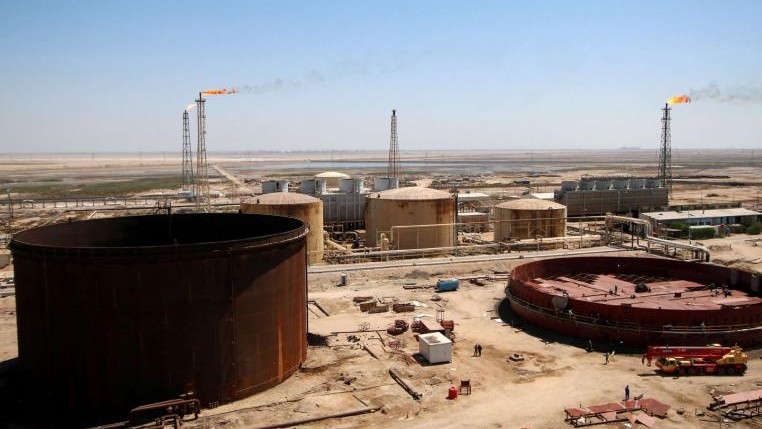
Iraq is aiming to significantly increase its oil production in the coming years, but obtaining approval from OPEC is crucial for this ambitious plan.
Iraq’s Production Goals and OPEC’s Role
Prime Minister Ali al-Zaidi announced that Baghdad’s goal is to boost oil output to between 8 million and 10 million barrels per day (bpd), a steep increase from the approximately 4 million bpd seen prior to the Iran war. To facilitate this escalation, Iraq’s oil and finance ministers met with officials in Saudi Arabia, advocating for a higher production quota from OPEC. The current discussions hinge on an independent assessment by consulting firm DeGolyer and MacNaughton, which is tasked with evaluating the maximum sustainable production capacity for OPEC members, including Iraq. Findings are expected by the end of September, initiating negotiations over production baselines for 2027.
Challenges in Increased Oil Export Capacity
Despite the potential for an approved higher production quota, Iraq faces substantial logistical hurdles that could impede its ability to export the desired volume. The nation’s oil output has been significantly affected by geopolitical tensions, particularly due to the effective closure of the Strait of Hormuz. This vital waterway has historically served as Iraq’s main avenue for crude oil exports. Recent efforts have seen Iraq increase exports through Hormuz to roughly 2 million bpd; however, this level remains below what was achieved before the conflict began.
To counterbalance these challenges, al-Zaidi mentioned initiatives to enhance exports via Turkey’s Ceyhan port and alternative routes through Syria’s Baniyas and Jordan’s Aqaba. Currently, the existing Iraq-Turkey pipeline is only funneling approximately 170,000 bpd, indicating that significant infrastructure improvements are necessary to reach production goals.
Infrastructure Investments and Future Prospects
Given the ambitious target of 8 million to 10 million bpd, the need for expanded infrastructure becomes evident. One proposal involves constructing a new pipeline to Syria, which would not only circumvent the Strait of Hormuz but could also serve to diversify Iraq’s export routes. However, estimates suggest that this pipeline could take around four years to complete and require investments of at least $15 billion. Such infrastructure projects are essential if Iraq is to meet its large-scale production goals. Additional investments may be critical to modernize existing facilities and enhance capacity further.
Shifts in Global Oil Demand
As Iraq works to ramp up production and improve transport capabilities, it is also experiencing shifts in global oil demand. Notably, China has increased its purchases of Iraqi crude, particularly after disruptions to traditional Middle Eastern supply routes. Recent dealings include the acquisition of 8 million barrels of Basrah Heavy and Basrah Medium, underscoring Iraq’s growing importance to the global oil market.
In summary, while Iraq is optimistic about its production aspirations, the road ahead requires careful navigation of both OPEC negotiations and significant investments in infrastructure. The interplay between regional politics and global oil demand will further shape Iraq’s oil future in the coming years.