
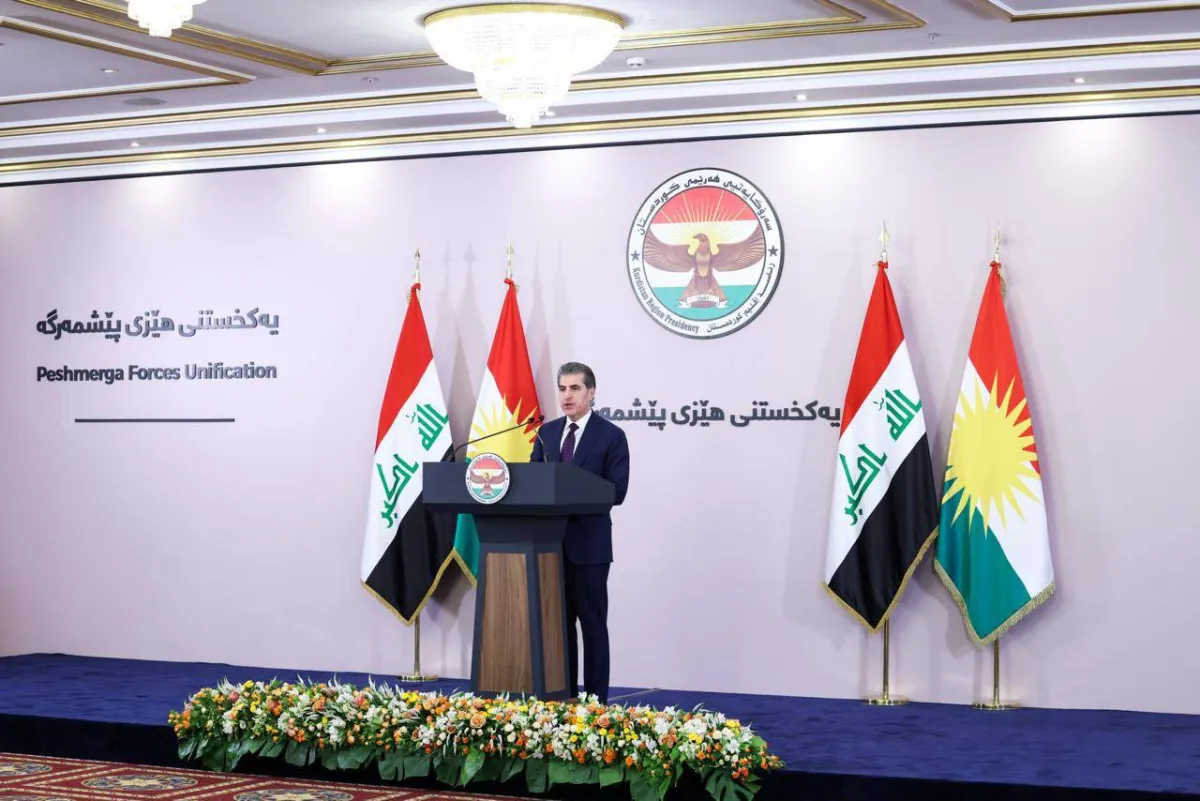
Iraq’s Kurdistan Region has officially announced the unification of its Peshmerga forces, a significant move after over three decades of division. This initiative aims to unify Kurdish factions that have long been separated by political and security issues. The ceremony, held in Erbil, marked a new chapter in Kurdish history, emphasizing the importance of unity in both military and socio-political spheres.
The Historical Context of Division
The Peshmerga forces experienced a split in the mid-1990s during the Kurdish civil war. This conflict arose primarily between two major parties: the Kurdistan Democratic Party (KDP) under Masoud Barzani and the Patriotic Union of Kurdistan (PUK), which was led by the late Jalal Talabani. This division resulted in the establishment of two distinct military units; Unit 80, associated with the KDP, was predominantly located in Erbil and Duhok, while Unit 70, linked to the PUK, was based in Sulaymaniyah and Halabja.
This separation not only fragmented the Peshmerga’s effectiveness but also complicated security strategies in the region. The recent unification ceremony, attended by President Nechirvan Barzani and Prime Minister Masrour Barzani, signifies a longer reform process aimed at consolidating and reorganizing the Peshmerga under a centralized military framework overseen by the Ministry of Peshmerga Affairs.
The Role of International Community
The integration of Peshmerga forces has had significant backing from the international community, especially the United States, Britain, and Germany. This unifying move is seen as a precondition for ongoing military assistance and logistical support from these nations. Kurdish authorities claim that the Peshmerga serves as an integral part of Iraq’s defense system, although they are not explicitly mentioned in the national constitution. Article 121 does allow for the establishment of regional security forces, which Kurdish leaders interpret as encompassing the Peshmerga.
Nechirvan Barzani highlighted the necessity for the Peshmerga to rise above political parties and defined the forces as protectors of all communities in Kurdistan, including Kurds, Turkmen, Christians, Yazidis, and Arabs. He believes that the unification will enhance coordination not just within the Kurdish region but also with Iraq’s federal armed forces, strengthening the nation as a whole.
Challenges Ahead for Kurdish Political Unity
Despite this historic unification, challenges regarding Kurdish political unity linger. The Kurdistan Region has faced nearly two years of stagnation in forming its regional government following parliamentary elections, indicating a deep-seated split. PUK official Soran Dawoodi expressed optimism that the unification of Peshmerga forces could serve as a stepping stone for political reconciliation between the KDP and PUK. Such consolidation might also bolster public confidence in the Peshmerga as a credible military force.
This newly unified structure aims not only to improve military effectiveness but also to provide a framework for institutionalized governance, which many Kurdish citizens have long demanded. Effective training, clear definitions of responsibilities, and adherence to military doctrine are all areas where Barzani emphasized the need for advancement; ensuring that the military remains free from political manipulation.
In conclusion, the formal unification of the Peshmerga forces represents an important milestone in Kurdistan’s journey toward military and political cohesion. While the initiative has garnered international support and holds promise for future stability, the quest for true political unity among Kurdish factions remains a critical challenge that must be addressed to capitalize on this newfound strength.