
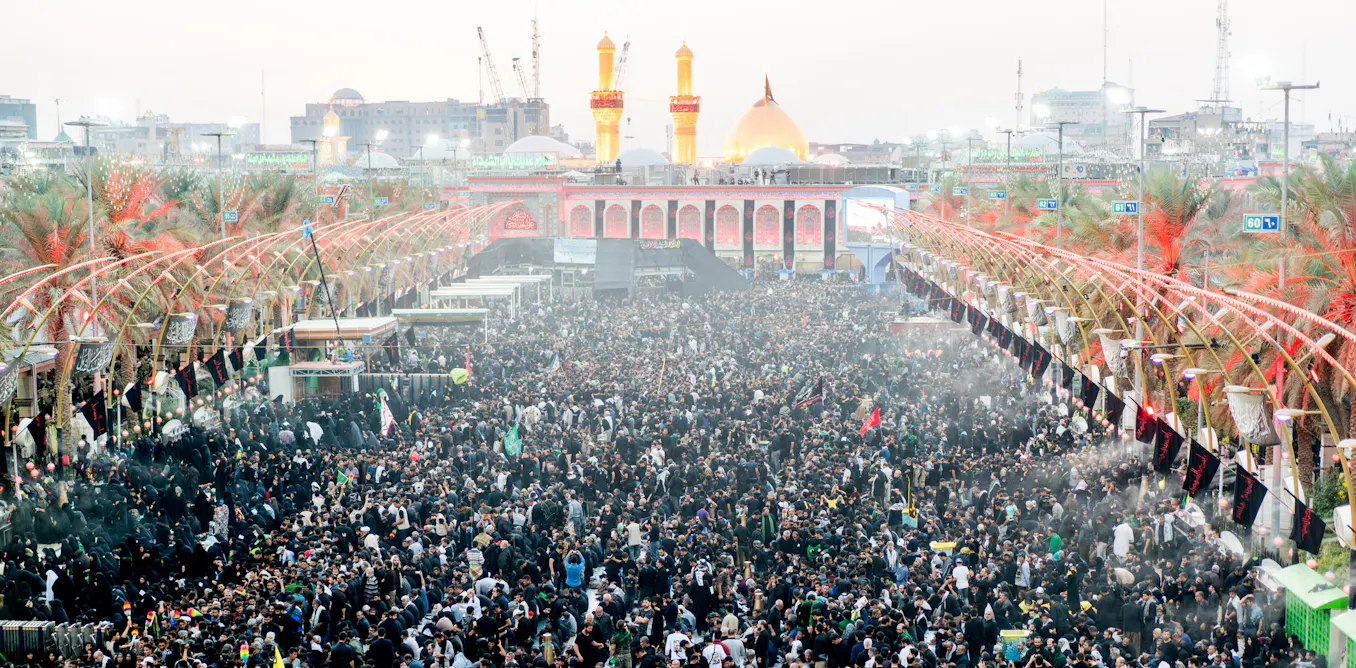
Every year, millions of pilgrims make a spiritual journey from the deserts of southern Iraq to the sacred city of Karbala for Arbaeen, recognized as one of the world’s largest religious gatherings. In 2026, this revered pilgrimage will culminate on August 5.
The Significance of Arbaeen
Arbaeen occurs 40 days after Ashura, a day devoted to honoring the martyrdom of Husayn ibn Ali, the grandson of the Prophet Muhammad, who was tragically killed in 680 C.E. This day marks the conclusion of a mourning period that begins in the Islamic month of Muharram. As a scholar specializing in Shiite communities, I observe that few traditions encapsulate the essence of Shiite Islam as profoundly as Arbaeen—its themes of sacrifice, injustice, and communal unity are deeply resonant.
To fully appreciate Arbaeen’s significance, one must revisit the events that took place in Karbala. After the death of Ali, Muhammad’s cousin, and subsequently his son Hasan, the Islamic caliphate was inherited by Yazid, the first hereditary ruler of the Umayyad dynasty. Husayn refused to acknowledge Yazid’s authority, believing he was unworthy of leading the Muslim community. In 680, despite being vastly outnumbered, Husayn and his small band of followers were confronted by Yazid’s formidable army. The aftermath of this battle was not merely a political defeat for Husayn but a poignant symbol of sacrifice for the preservation of true faith.
A Journey of Remembrance
The memory of Husayn’s martyrdom carries profound implications for Shiite Muslims, offering insights into the teachings of the Prophet and his family. His sacrifice epitomizes the eternal struggle between good and evil, urging believers to adhere to their moral values despite adversity. Following the tragedy at Karbala, survivors who had been taken captive were eventually able to visit Husayn’s grave, marking the beginning of a pilgrimage tradition defined by faith and remembrance. Arbaeen serves as a powerful assertion that even in loss, hope can be restored.
In contemporary times, the most popular route for pilgrims extends roughly 48 miles from Najaf, where Ali is interred, to the shrine of Husayn in Karbala—a journey that typically lasts about three days. Along the path, volunteers set up “mawakib,” offering pilgrims food, medical care, and a place to rest. Having experienced this pilgrimage firsthand, I was astounded by the spirit of hospitality that emerged even from a nation beset by years of conflict. The story of Husayn’s sacrifice continues to inspire remarkable generosity.
Recent estimates suggest that more than 20 million participants engage in Arbaeen, making it one of the largest annual gatherings worldwide. This gathering stands in stark contrast to the era of Saddam Hussein, whose regime imposed severe restrictions on public Shiite mourning. The resurgence of the Arbaeen pilgrimage after the U.S.-led invasion in 2003 marks a significant cultural revival, attracting millions from diverse backgrounds.
A Source of Inspiration
For many Shiite Muslims, Husayn’s martyrdom transcends historical events; it is a source of continual inspiration. His sacrifice has fostered not only spiritual devotion but also a framework for political resistance. Scholars like Syed Akbar Hyder highlight the “Karbala paradigm” as a model for opposing tyranny. Ayatollah Khomeini famously drew parallels between the shah of Iran and Yazid to galvanize support during the Iranian Revolution of 1979.
The narrative of Husayn’s death resonates deeply within Shiite communities, sparking creative expressions such as poetry and theatrical performances that contextualize his story for contemporary audiences. One notable work is “The Battle of Karbala,” a 19th-century Urdu epic written by poet Mir Anees. It encapsulates the heartache of Husayn’s daughter, Sakina, as she searches for her father amidst the chaos of battle.
For those who participate in Arbaeen each year, standing at Husayn’s grave is not just an act of homage to a historical figure but a reaffirmation that his stand against injustice holds relevance today. This pilgrimage is a powerful reminder that the struggle for righteousness continues, establishing a profound bridge between past and present.