
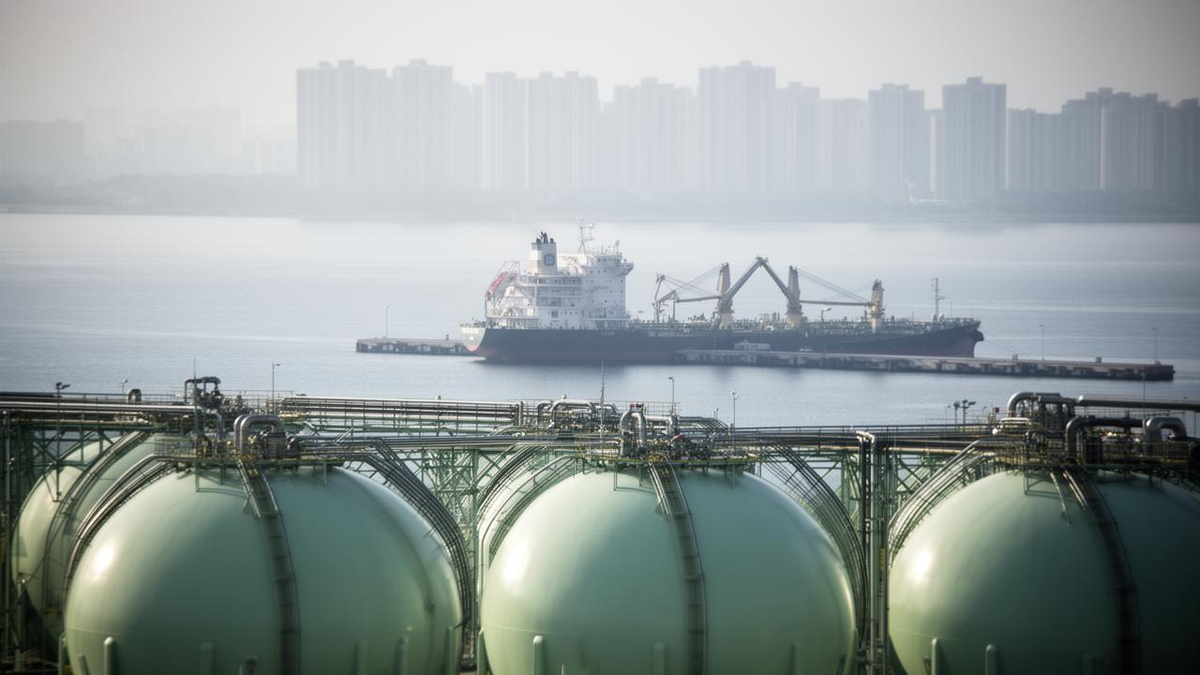
The ongoing conflict in the Middle East has significantly altered South Korea’s liquefied natural gas (LNG) import dynamics. Between January and September of this year, imports of Middle Eastern LNG dropped by over 66% compared to the previous year, while imports from North America saw a remarkable increase, more than doubling. This shift indicates a substantial realignment in South Korea’s energy supply strategy, moving the focus from the Middle East toward suppliers in North America.
Declining Imports from the Middle East
Recent statistics from the Korea International Trade Association reveal that South Korea’s total LNG imports reached 32.87 million tonnes, reflecting a 6.4% decline from the same period last year. The reduction in overall imports contrasts sharply with the steep decline in LNG sourced from the Middle East, which fell by 66.2% to just 2.42 million tonnes. Conversely, imports from Central and South America and Europe also saw declines of 17.8% and 12.7% respectively, underscoring a broader regional impact on LNG supply.
The primary source of disruption stems from Qatar, which experienced a staggering 68.6% decrease in LNG exports to South Korea, with zero imports recorded during specific months such as April to June and August to September. Once South Korea’s third-largest supplier, Qatar has now faced significant challenges due to the ongoing conflict, leading to severe consequences for the energy markets in the region.
Surge in North American Imports
In stark contrast to the decline seen from the Middle East, South Korea’s imports of North American LNG have surged by 102.9% year-over-year, totaling 7.82 million tonnes. The rise in volumes from the U.S. increased by 41.7% to 4.85 million tonnes, while imports from Canada skyrocketed by an astonishing 587.6%, reaching 2.97 million tonnes. In response to the disruptions from the Middle East, the South Korean government has taken proactive measures to secure replacement LNG cargoes from the United States and Southeast Asia.
As supply chains undergo this significant reshuffling, international LNG prices are escalating. In August, the Japan Korea Marker (JKM), which serves as the benchmark for East Asia, recorded a 15.2% increase month-over-month, reaching $22.0 per MMBtu. Similarly, the European gas price benchmark, TTF, climbed 17.1% to $21.2. As winter approaches and demand rises, concerns are mounting that heightened competition for available LNG cargoes may further intensify price pressures.
Reevaluating the Alaska LNG Project
This uncertainty around supply has prompted the South Korean government to reassess its approach to the Alaska LNG project, which was previously sidelined due to concerns over its commercial viability. Minister of Trade, Industry and Energy, Kim Jung-kwan, noted that the geopolitical turmoil in the Middle East has introduced a new strategic importance to the project. Challenges in securing Middle Eastern LNG—exacerbated by rerouted cargoes due to regional bottlenecks—have led officials to reconsider their stance.
Despite the renewed interest, significant hurdles remain in establishing commercial viability for the Alaska project. Reports estimate that the project costs could be as high as $54.5 billion, raising questions about profitability given the extensive capital involved. Additionally, permitting delays and labor shortages further complicate the endeavor. Experts suggest that while the strategic benefits of Alaska LNG are clear, economic feasibility must be critically evaluated.
As tensions in the Middle East persist, South Korea’s energy security landscape is evolving. The government aims to balance supply diversification with North America and Southeast Asia, while also fostering long-term contracts and exploring strategic options like the Alaska project. The path to a normalized global LNG supply remains uncertain, as geopolitical risks in the region show little sign of resolution in the near future.