
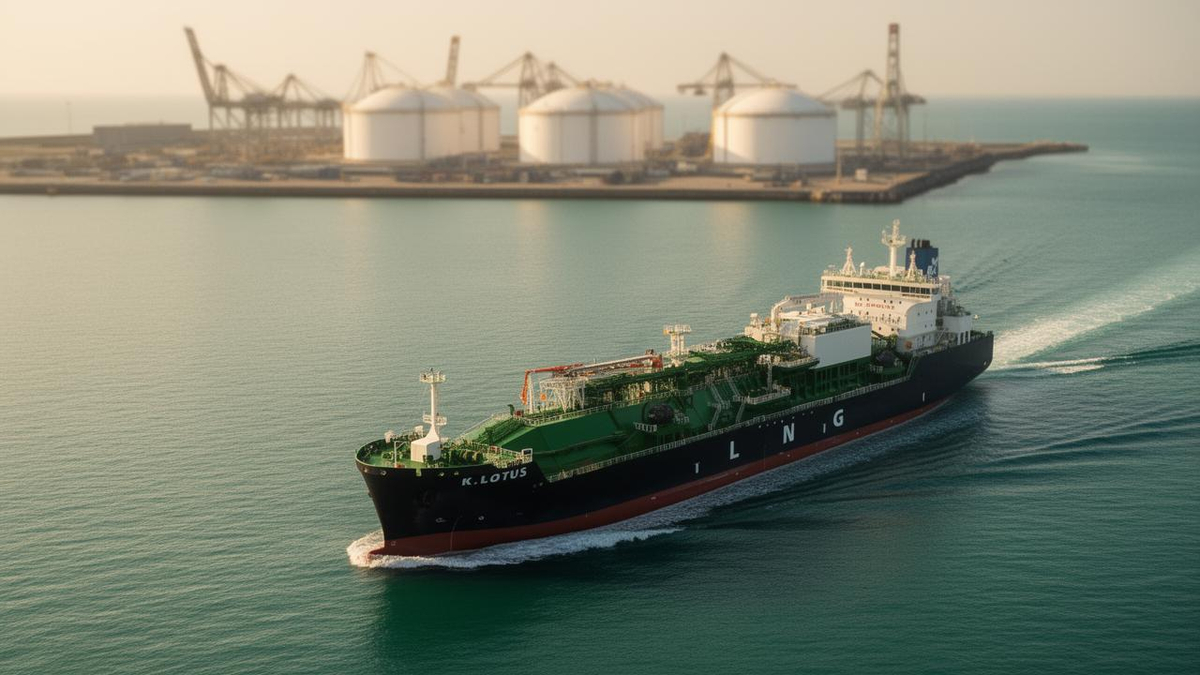
The ongoing U.S.-Iran conflict has disrupted Qatar’s liquefied natural gas (LNG) export routes, leading to a rise in American LNG’s market share. This shift is notable as South Korea has significantly cut back on its imports from Qatar, opting instead for U.S. LNG. This change allows companies that import LNG directly from overseas, bypassing traditional market intermediaries like Korea Gas Corporation, to take advantage of lower prices and potential increases in power sales revenues.
Qatar’s LNG Challenges
Energy industry insiders report that QatarEnergy, the state-run LNG supplier in Qatar, is now in talks to secure 2–3 million tons of U.S. LNG each year. This marks an unexpected pivot for a nation that typically oversees around 80% of LNG exports from the Middle East. The necessity of importing American natural gas is widely seen as a reaction to the devastating impact of the U.S.-Iran war, which has crippled Qatar’s own LNG production capabilities. With reported damages estimated at 12.8 million tons—about 17% of Qatar’s LNG facilities and equivalent to around 3% of the world’s total supply—the timeline for restoring production could stretch from three to five years. Since March, Qatar has been declaring force majeure on deliveries, underscoring the severity of the situation.
The figures illustrate the drastic drop in Qatari LNG exports, which plummeted by 96% year-over-year from March to the current period. LNG transit through the critical Strait of Hormuz to Asian markets has also seen an 88% decline, resulting in only 4.45 million tons transported. Furthermore, Qatar’s aspirations to expand its LNG production capacity by 85%, aiming for a total output of 142 million tons, have been significantly impeded.
The Rising Role of U.S. LNG
In response to Qatar’s supply challenges, U.S. LNG exports have surged, with a 23% increase in the first half of this year compared to last year. In the second quarter of 2023 alone, exports to Asia reached an unprecedented 10.9 million tons. As part of this evolution, South Korea has restructured its LNG import sources. Notably, from January through August, the breakdown of LNG imports was as follows: Australia (28.3%), Malaysia (17%), the United States (15.1%), and Qatar (5.8%). A year earlier, Qatar’s share was significantly higher at 15.6%, marking a decrease of nearly 10 percentage points, clearly showing the growing impact of U.S. LNG.
The competitive pricing of American LNG is a major draw for direct importers. For instance, the projected per-ton import prices for 2024 reveal that Qatari LNG is priced at $745, while Australian, Malaysian, and U.S. LNG are considerably cheaper at $628, $552, and $549, respectively. This price disparity presents a compelling case for power generators to seek out U.S. LNG instead of more costly options.
Advantages for Direct-Import Power Generators
South Korean firms that import LNG directly for power generation—including SK E&S, SK Gas, and others—are well-positioned to capitalize on this shift. Traditionally, LNG imports have been handled by Korea Gas Corporation, which adds overhead costs. However, direct importers can source LNG directly, catering to their own fuel requirements. As one direct importer noted, having long-term contracts at higher prices can be financially burdensome, making the switch to U.S. LNG a strategic move to cut costs.
Additionally, as international LNG prices have surged in the wake of the conflict, the wholesale power purchase costs have followed suit. Direct power generators can leverage these rising prices to sell electricity at elevated rates, thus optimizing revenue. Reports indicate that since the conflict’s escalation, the spot price for LNG in Northeast Asia has fluctuated dramatically, reinforcing the need for cost-effective sourcing.
Moreover, companies with stakes in overseas gas fields are positioned to benefit from the current market dynamics. With direct imports, they sidestep the inflated prices affecting resale, allowing them to sustain profitability. Notably, firms like SK E&S and POSCO International have made strategic investments that promise substantial LNG supplies in the coming years.