
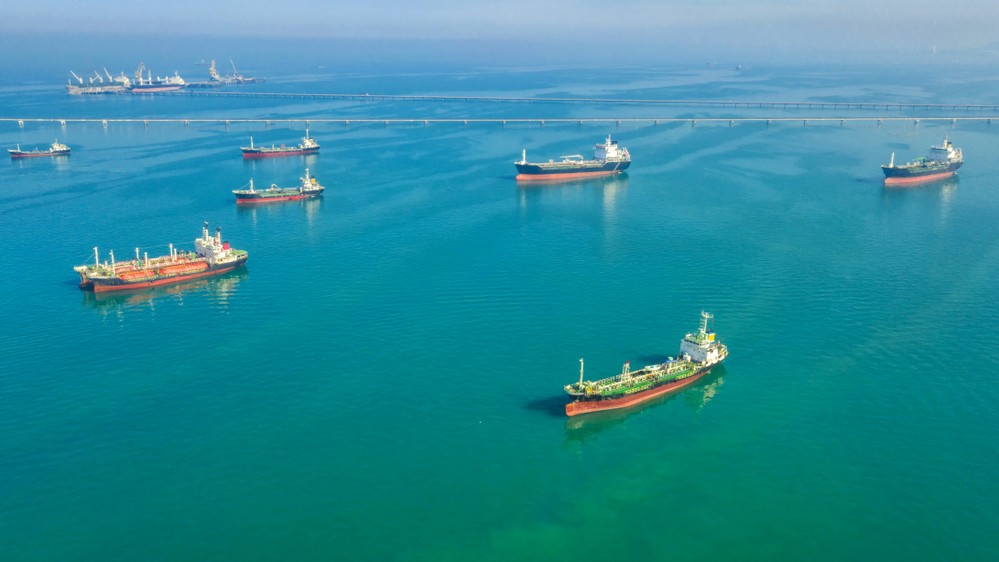
Two large crude carriers loaded with Saudi oil are making their way to the Strait of Hormuz, signaling a rebound in traffic through this critical oil passage. These supertankers, operated by Japanese firms Nippon Yusen KK and Kawasaki Kisen Kaisha, recently took on their cargo and now face significant challenges as they navigate through the region, which has seen recent tensions and disruptions.
Crude Carriers Await Safe Passage
According to data from Kpler, these two very large crude carriers (VLCCs) loaded their shipments of Saudi crude on March 1. However, they have encountered delays within the Strait of Hormuz, primarily due to Iran’s decision to halt traffic through this vital channel. As the tankers sit fully loaded, they are poised to transport a total of 4 million barrels of crude oil to Japan once conditions allow for safe passage.
On July 4, reports indicated that only 25 vessels successfully navigated the strait that day, highlighting the current state of commercial traffic that remains around one-third of its pre-war transit level. This situation is exacerbated by rising geopolitical tensions, as at least four tankers had to reverse their course shortly after receiving warnings from Iran’s Islamic Revolutionary Guard Corps, illustrating the risks that still loom over shipping routes in this contested area.
Recent Maritime Developments
Interestingly, the latest reports indicate a degree of recovery in oil exports, even as the number of vessels transiting the Strait of Hormuz remains limited. Since the U.S. and Iran’s preliminary ceasefire agreement in mid-June, Saudi Arabia has managed to ship approximately 34 million barrels of crude through the strait. Concurrently, the United Arab Emirates has ramped up its exports via the waterway, achieving record oil export levels for June. Nonetheless, the pace of recovery in maritime traffic continues to be inconsistent, as not all vessels are proceeding to their original destinations without hesitation.
In a puzzling turn of events, multiple tankers, including at least eight oil and liquefied natural gas (LNG) carriers, made unexpected U-turns while approaching the waterway recently. This strange behavior occurred off the coast of Oman and raises questions about the conditions or orders these vessels may have encountered. Among those that changed course, several veered toward the lane controlled by Iran, while others stayed closer to the Oman coastline.
Future Implications for Strait of Hormuz Traffic
As the situation in the region evolves, the implications for oil transportation through the Strait of Hormuz become more significant. The strait remains a crucial transit point, with nearly a fifth of the world’s total oil supply passing through it. The recovery from disruptions caused by geopolitical tensions is fragile, leading to uncertainties regarding future shipments. Companies relying on this route must navigate both market conditions and geopolitical dynamics, making careful assessments about the risks involved in transporting oil through this strategic chokepoint.
As trade continues to shift and adapt in response to these developments, stakeholders across the oil supply chain must keep a close eye on changes in maritime traffic trends and geopolitical events that could affect operations in the Strait of Hormuz.