
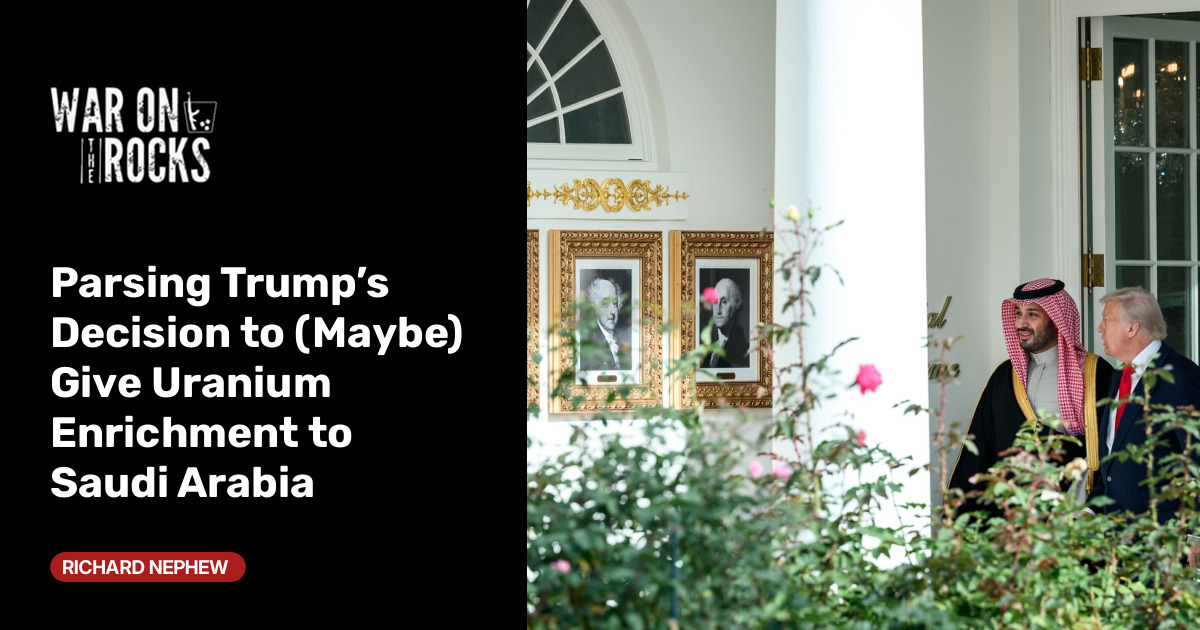
On June 22, the United States revealed that it had entered into a nuclear cooperation agreement with Saudi Arabia. Such treaties typically permit the exchange of nuclear technology, equipment, and materials, contingent upon meeting specific nonproliferation standards. These agreements are formally designated as Section 123 agreements, named after the relevant section of the 1957 U.S. Atomic Energy Act that specifies the conditions for these deals. While legal requirements establish the baseline for nuclear cooperation, U.S. nonproliferation policies over the years have usually mandated more stringent measures. Reports suggest that the Trump administration relaxed some of these key policies—including restrictions on uranium enrichment technology—to expedite the agreement.
### Concerns Over Saudi Nuclear Ambitions
The potential for Saudi Arabia to pursue nuclear weapons in response to Iran’s program has long been a contentious issue in U.S. politics. Concerns escalated when Saudi officials indicated an intent to match Iran’s nuclear capabilities, including the development of nuclear weapons if necessary. This has raised numerous questions about Saudi nuclear activities, many of which remain unsubstantiated but are nonetheless alarming. The U.S. concessions in this agreement—such as enabling Saudi uranium enrichment technology and the option to decline extensive international inspections—exacerbate these anxieties.
The fate of this agreement is uncertain, particularly given President Trump’s inclination to leverage the nuclear deal as a bargaining chip in broader diplomatic efforts with Saudi Arabia and Israel. This issue was a significant hurdle during the Biden administration’s pursuit of its own nuclear deal, as well. Press reports indicate that Trump’s team abandoned efforts to tie normalization with Israel to nuclear negotiations, which complicates the deal’s prospects and raises the likelihood of renewed scrutiny.
### Implications of U.S. Nonproliferation Policies
U.S. nonproliferation policies stipulate that any country engaged in a Section 123 agreement must ensure full inspections of its nuclear facilities by the International Atomic Energy Agency (IAEA), maintain security for any nuclear material transferred, and not retransfer nuclear material without U.S. approval. These stipulations aim to provide the U.S. with assurance that it is not inadvertently enabling nuclear weapons development. Although these requirements serve as a legal foundation, the U.S. has historically sought to enhance nonproliferation standards globally, particularly after revelations concerning Iran’s and Libya’s nuclear activities.
Despite attempts to adopt broader nonproliferation standards, the U.S. has faced challenges in convincing other nations to comply, particularly given competition from countries like Russia and China. The 2009 nuclear cooperation agreement with the United Arab Emirates, often regarded as the “gold standard,” included stringent requirements for no enrichment or reprocessing capabilities. However, achieving similar commitments from other nations has proven elusive, particularly in the case of Saudi Arabia.
### Recommendations for Moving Forward
Considering the complexities outlined, it’s essential to amend the nuclear agreement with Saudi Arabia. Change could stem from either the executive branch, which may choose not to present the agreement to Congress amid concerns over normalization with Israel, or Congress exercising its oversight capacity. Should the appropriated agreements not fully address concerns, particularly involving inspections and technology transfer, the situation could lead to future diplomatic complications.
Effective amendments should focus on fine-tuning the inspections conducted in Saudi Arabia while establishing a framework for technology transfer that aligns with nonproliferation goals. The U.S. might need to weigh the potential benefits of a conditional approach that permits a limited understanding of enrichment technology, provided adequate safeguards and inspections are maintained.
In sum, modifications to the Saudi nuclear agreement should prioritize nonproliferation while allowing for technological cooperation. Such initiatives would not only align with U.S. interests but might also reduce regional tensions, particularly relating to Israel’s security concerns. Comprehensive scrutiny and potential revisions to the agreement could prevent undesirable precedents in nuclear cooperation and fortify U.S. commitments to global nonproliferation efforts.