
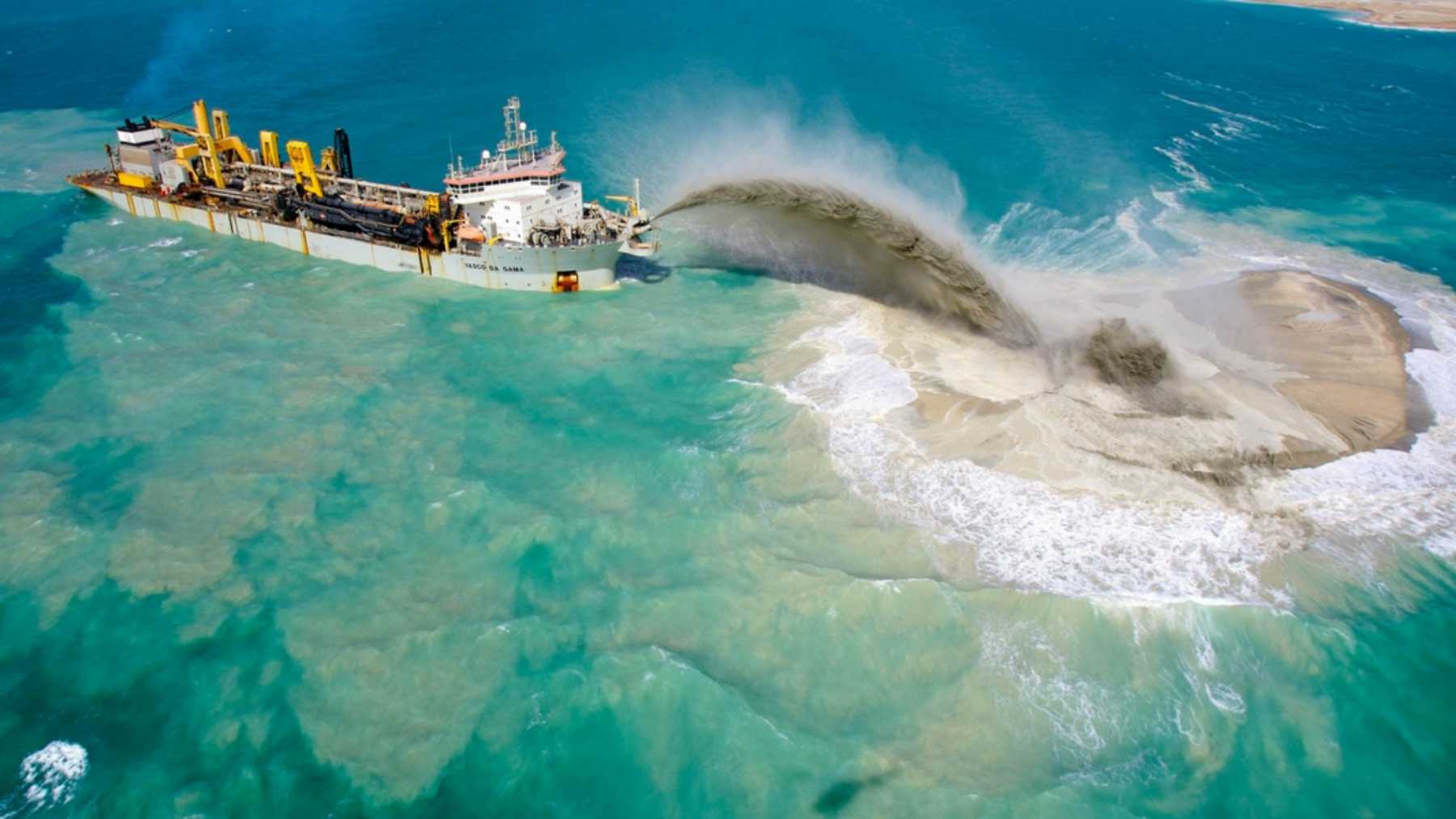
Saudi Arabia, although predominantly a desert landscape, faces a surprising challenge in construction: it imports sand. The Rub’ al Khali, or the Empty Quarter, is the largest continuous sand sea in the world, yet the local sand is inadequate for modern concrete needs. Instead of relying on its vast sandy terrain, Saudi Arabia, along with the UAE and Qatar, imports construction-grade sand to meet the demands of its ambitious building projects.
Why Local Sand Lacks Quality
Concrete is primarily composed of aggregates like sand and gravel, which are bound together by cement. For the concrete to possess optimal strength, the grains of sand must interlock effectively. Sand sourced from rivers and crushed rock has angular and jagged edges that mesh well when mixed with cement, creating a solid structure. Conversely, desert sand has been smoothed by wind over thousands of years into rounded granules. When mixed into concrete, these smoother grains act more like ball bearings rather than gripping onto one another, resulting in weaker structures. Additionally, desert sands commonly contain salt, which can corrode the steel that reinforces concrete structures, further complicating their use.
For years, engineers have tried to find a solution that would make desert sand viable for construction. Research teams such as those from Imperial College London have developed alternatives, like a composite material called Finite, designed for this specific purpose. However, these innovations haven’t yet eliminated the most straightforward solution: transporting suitable sand from elsewhere.
The Global Sand Trade Landscape
The demand for quality building sand has led to a thriving international trade. The United States and Australia are the largest exporters, with millions of dollars worth of sand sold each year, significantly to countries in the Gulf. While the amount exported is substantial, the volumes imported by Arabian nations remain surprisingly low in comparison. For example, Saudi Arabia imported only about $140,000 worth of sand from Australia in 2023—a modest figure for a nation sitting atop vast sand reserves, highlighting a growing dependency on foreign suppliers.
This paradox becomes clearer when examining high-profile construction projects such as Palm Jumeirah in Dubai. Constructed from millions of cubic meters of specific sand dredged from the Persian Gulf, it showcases how local supplies are inadequate for ambitious engineering endeavors. Similarly, the Burj Khalifa utilized sand sourced outside the UAE to achieve its impressive height and structure. The rapid pace of development in the Gulf means that the reliance on imported sand will likely grow more pronounced, with projects like Saudi Arabia’s Vision 2030 generating increased demand for high-quality building materials.
The Expanding Global Sand Crisis
The gulf’s sand dilemma reflects a larger global issue. According to the UN Environment Programme, humans extract approximately 50 billion tons of sand annually, making it the second-most-exploited natural resource after water. This widespread demand is expected to surge by 45% by 2060, exacerbating the gap between extraction rates and natural replenishment. The UN has coined the term “sand gap” to describe this disparity, emphasizing the competition between sand used for construction and that which is critically needed for ecological balance.
As the world continues to urbanize rapidly, the need for suitable construction materials becomes increasingly urgent. However, the various types of sand serve different purposes, complicating the situation further. The round grains perfect for desert beauty fail to meet the mechanical needs of modern construction. Thus, the most ordinary material becomes embroiled in a significant supply challenge, raising questions about sustainability and resource management as the global demand for sand continues to surge.
As the narrative evolves, this paradox of a desert nation importing sand offers a striking reminder of the complexities involved in construction and resource dependency. In a world where engineering feats are met with unprecedented demands, the quest for adequate building materials is as critical as ever.