
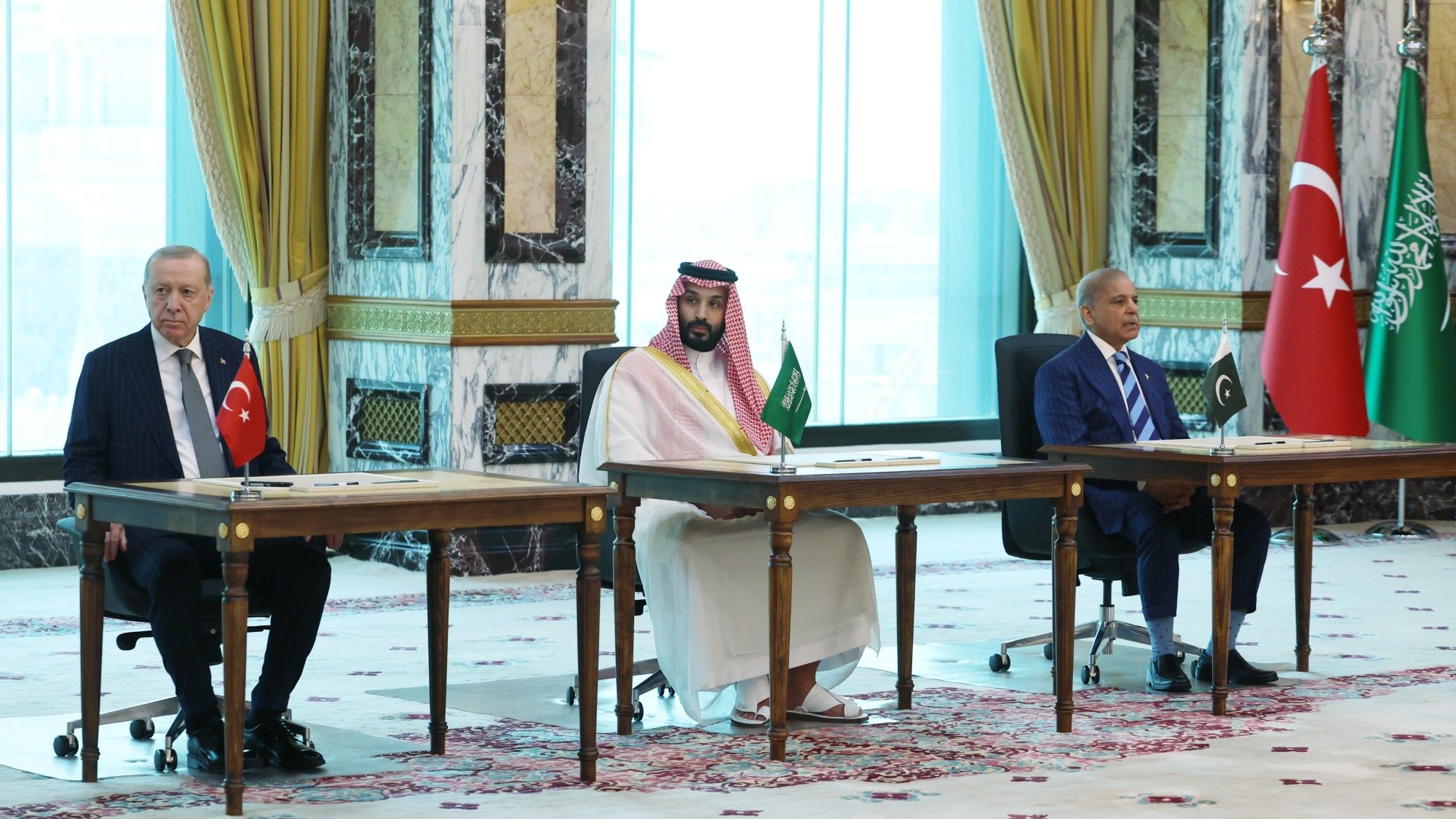
A significant realignment is underway in Middle Eastern geopolitics, marking what many analysts are calling a “tectonic shift.” Recent developments have seen Saudi Arabia, Turkey, and Pakistan form an unprecedented military alliance, highlighted by the Mecca Joint Defence Agreement signed on August 7. This pact represents a crucial evolution in the security dynamics of the region, positioning itself as a collective defense mechanism that echoes NATO’s Article 5, asserting that an attack on one member will be viewed as an attack on all.
Shifting Alliances in the Middle East
Historically, Saudi Arabia has been hesitant to engage in multilateral agreements, often opting for bilateral partnerships, such as its earlier arrangement with Pakistan. This dependency on individual alliances, coupled with reliance on U.S. support for security, is being reconsidered in light of increased aggression from Iran. The shifting political landscape, characterized by attacks on Saudi soil by Iranian forces and their proxies, has compelled the Kingdom to rethink its strategic posture.
This newly formed alliance leverages a threefold advantage. First, Saudi Arabia brings significant financial resources to the table, bolstering overall military capabilities. Second, Turkey contributes its standing as a NATO member, possessing one of the largest military forces in that alliance, coupled with a robust arms manufacturing sector. Finally, Pakistan adds a battle-hardened military experience and its status as the only nuclear power in the Muslim world. These collective resources are poised to reshape the strategic calculations of both allies and adversaries alike.
The Framework of Cooperation
While the Mecca Agreement symbolizes a significant step in regional cooperation, experts caution against overestimating its potential. Unlike NATO, this alliance lacks a formal command structure, joint military doctrines, and a unified budget. Instead, it serves more as a framework for enhanced practical military and political collaboration, empowering the member states to lessen their historical reliance on the United States for security. This move makes strategic sense amidst ongoing geopolitical volatility, where American influence appears increasingly uncertain.
Washington has not yet expressed significant concern over this evolving alliance, which is noteworthy. The U.S. continues to maintain positive relations with all three nations and has long advocated for increased regional self-reliance. However, as this alliance solidifies, there is a strong possibility that American leverage will wane, particularly concerning arms transactions and management of emerging regional crises.
Counterbalancing Regional Powers
In an environment where U.S. influence is diminishing, countries like Iran and Israel could take on greater roles in shaping regional affairs. The Mecca Agreement aims to establish a “third pole,” countering any potential hegemony by these states. The alliance seeks to forge stronger ties and collaborate on military innovations, including the development of advanced weaponry and defense systems on Saudi soil.
For Israel, the implications of this alliance are particularly concerning. The transformation of Turkey from an ally to a perceived threat, alongside Saudi Arabia’s strategic redirection, creates a challenging environment for Israeli interests. The newfound military cooperation among Saudi Arabia, Turkey, and Pakistan may well represent a strategic pivot that complicates Israel’s security calculus, shifting the balance of power in significant ways.
The first significant test of this partnership may arise in Yemen, where tensions with the Iran-aligned Houthis are resurfacing following the collapse of a ceasefire. An escalated response from this military alliance would mark a crucial moment, potentially establishing a new norm in regional security dynamics. The ongoing challenge will be to craft responses that ensure deterrence while avoiding the escalation to further conflict. Balancing these competing needs will be essential for the new alliance’s credibility and long-term viability in a rapidly changing geopolitical landscape.