
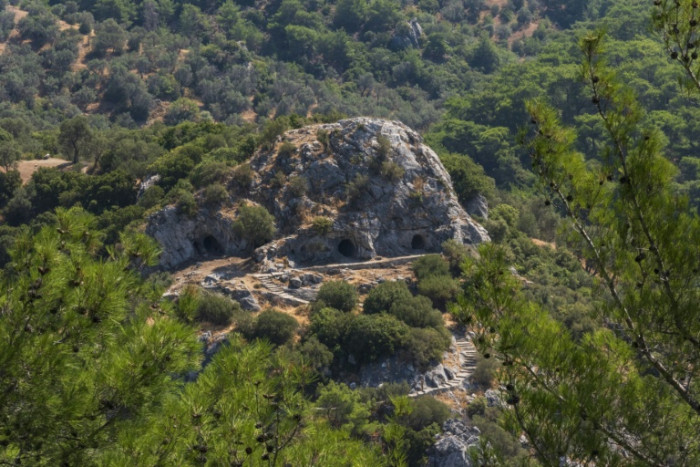
Homer, the legendary author of “The Odyssey,” has long been associated with a cave nestled in the hills of Bornova, Turkey. This picturesque location, overlooking lush olive groves near Izmir, is a focal point of fascination for locals and visitors alike. The site is often referred to as “Homer’s Valley,” a name that reflects its historical significance and the deep-rooted connection between the poet and this region.
The Cave and Its Legacy
According to Turkish researcher Altan Altin, the cave has been a pilgrimage site for travelers curious about the origins of one of the greatest poets in history. “People have long visited the cave where Homer is believed to have written his masterpieces,” Altin comments, highlighting the mystery and allure surrounding this location. While no definitive evidence exists to pinpoint the exact place where Homer penned his epic poems, the legend continues to thrive, fueled by cultural nostalgia and recent cinematic portrayals like Christopher Nolan’s film adaptation.
The association between Homer and Izmir, historically known as ancient Smyrna, has been celebrated for centuries. Greek chronicler Pausanias noted that the river Meles, reputed for its enchanting waters, was the site where Homer is said to have drawn inspiration. These historical mentions have spawned an ongoing debate regarding the poet’s origins, specifically the location of the river and the year of his birth, estimated to be around 8 BC.
The Cultural Significance of Bornova
Visiting the cave is not without its challenges, as travelers must navigate through rocky terrain. Visitors often leave inscriptions in Greek on the cave walls, though the origins of these writings remain uncertain. While other locations, especially the Greek island of Chios, also claim Homo’s birthplace, Bornova and its surrounding areas are frequently highlighted in discussions about the poet’s legacy. Altin asserts that there is no doubt Homer originated from this region, emphasizing that Ionia—a historic area along Turkey’s Aegean coast—includes both Smyrna and Chios within its geographical scope.
Artifacts uncovered in the region lend credence to the deep connections between Homer and Bornova. Archaeologist Mehmet Akif Erdem points to discoveries like coins bearing the poet’s likeness. “The people of ancient Smyrna engaged with Homer as one of their own,” he states. Moreover, the dialects in which “The Iliad” and “The Odyssey” were composed further suggest ties to this ancient land.
Modern Interpretations and Debates
The spirit of Homer is palpable throughout Bornova, particularly in sites like Yesilova Hoyuk, where a bust of the poet stands proudly with an inscription indicating his connection to the land. The local community actively celebrates this heritage, hosting book fairs and events dedicated to Homer. Mayor Omer Eski has expressed a commitment to preserving this cultural legacy, asserting, “Homer is one of the founding fathers of literature. His stories are about this land, and we must honor that.”
However, not all residents share the same vision. In 2024, officials from President Recep Tayyip Erdogan’s ruling AKP party suggested renaming Homer’s Valley, advocating for a more nationalistic representation. This sparked backlash, with local leaders reinforcing that erasing Homer’s name would undermine the area’s rich history.
Homer’s influence has also been revitalized in contemporary culture, particularly following the success of Nolan’s film adaptation. Local bookstores have reported a surge in interest, and citizens express pride in their connection to this iconic figure. “I am proud and honored to be his compatriot,” remarked a local teacher, reflecting the community’s growing appreciation for its literary heritage. As Altin summarizes, “Homer belongs to all of us—he is both Greek and Anatolian.” This sentiment underscores a broader understanding that the essence of Homer transcends boundaries, belonging to humanity at large.