
Turkey’s Military Expansion in Syria: Israel’s Stance at the UN
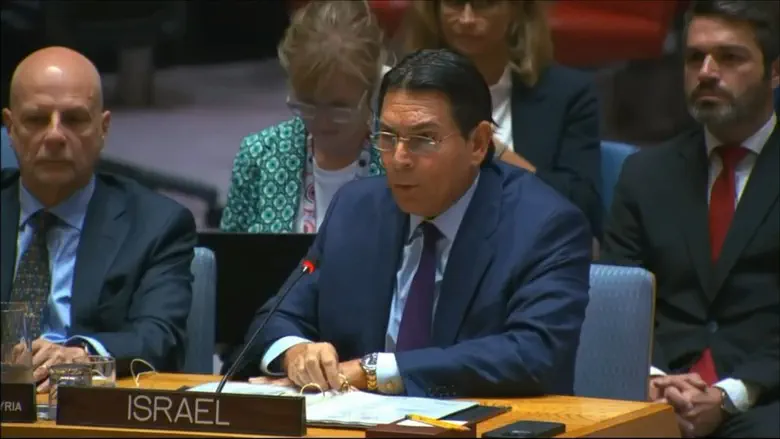
Israel’s Ambassador to the United Nations, Danny Danon, recently expressed grave concerns about Turkey’s increasing military activities in Syria. During a Security Council meeting, he clarified that Israel would not permit Syrian territory to serve as a launch point for threats against it. This debate over foreign military presence in Syria has serious implications for regional stability and international security.
Turkey’s Military Presence vs. Israel’s Security Buffer Zone
In his address, Danon showcased a map illustrating the contrast between Israel’s modest security buffer zone and Turkey’s extensive military foothold in Syria. While Israel maintains a security buffer area constituting only about 0.1% of Syrian territory, Turkey’s involvement spans approximately 5% of the nation—an area significantly larger, being 50 times the size of Israel’s own buffer.
Danon stated, “Turkey is following the Iranian proxy playbook,” emphasizing that Turkey’s actions signal a deepening military commitment to the region. He highlighted that Turkey is not just establishing a presence but is actively enhancing its military influence, which raises alarms for nations across the globe concerned with sovereignty and territorial integrity.
Double Standards on Sovereignty
The Israeli ambassador underscored the need for a consistent approach to sovereignty, questioning why the international community applies different standards to Israel compared to Turkey. Danon remarked, “If Syrian sovereignty truly matters to the international community, it cannot apply one standard to Israel and another to Turkey.” This sentiment echoed throughout his address as he pressed the necessity for equal scrutiny of military actions by all nations involved.
In a pointed criticism, Danon addressed Turkey’s ambition to take control of the Abu al-Duhur Airbase, reinforcing that Israel had set a clear boundary regarding this strategic location. “We asked Syria to prevent Turkey from taking control of the Abu al-Duhur Airbase. That was our red line,” he insisted. The implications of such control, he argued, would not be tolerated and could lead to dangerous escalations in the already volatile region.
Israel’s Response and the International Community
Danon asserted that Israel had communicated unequivocally to Syria the consequences of allowing Turkish forces to solidify their control over vital military locations. “When Syria ignored that message, we sent it in another way. Israel will not allow Syrian territory to become a base from which it can be threatened.” This strong stance illustrates Israel’s commitment to maintaining security while navigating a complex geopolitical landscape.
Furthermore, Danon directly challenged the representatives of the international community at the UN, accusing them of selective outrage. “When Israel acts in its own defense, this Council is quick to condemn. But when Turkey expands its military presence inside Syria, you remain silent.” His remarks highlighted a pervasive double standard, where military actions by Israel draw immediate condemnation, whereas Turkey’s expansion remains largely unaddressed.
In conclusion, as diplomatic discussions continue at the UN regarding Syrian sovereignty and military presence, the issue of Turkey’s growing influence in the region poses a significant challenge. Israel’s position, as articulated by Danon, raises vital questions about international accountability and the necessity for consistent responses to military actions, underscoring the complexity of maintaining peace in a region rife with tensions.