
The Black Sea has evolved into a critical geopolitical battleground in the wake of Russia’s full-scale invasion of Ukraine over four years ago. Interestingly, experts note that despite its strategic significance, the sea is currently lacking in naval presence, which Thomas de Waal, a senior fellow at Carnegie Europe, describes as a paradox. To grasp the intricacies of this situation, it’s essential to consider the geographical and political landscape surrounding the Black Sea.
The Geopolitical Landscape of the Black Sea
The Black Sea borders six nations: Turkey, Bulgaria, Romania, Ukraine, Russia, and Georgia. Among these, Turkey, Bulgaria, and Romania are NATO members, forming a western coalition. In contrast, Russia, Ukraine, and Georgia are not part of NATO, with Ukraine and Russia currently embroiled in conflict. This complex web of alliances complicates security dynamics in the region. The narrow Turkish Straits serve as the only gateway for maritime access to the Black Sea, and this geographic bottleneck has significant implications for trade and military strategy.
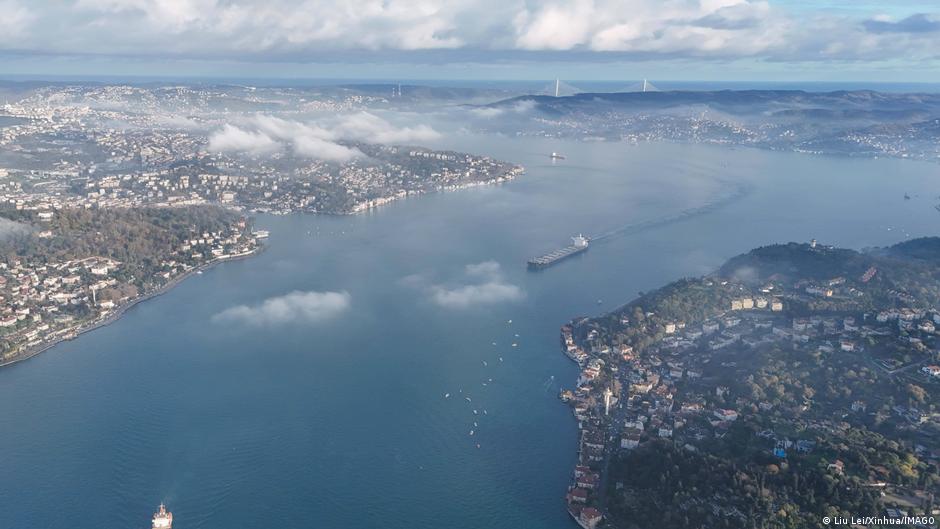
The access point comprises the Dardanelles and the Bosporus straits, with the latter narrowing to just 700 meters at its tightest. This pivotal passageway greatly influences economic and military maneuvers, as controlling these straits equates to having a substantial influence over the maritime activities within the Black Sea. According to de Waal, whoever governs these waterways gains a considerable advantage in trade and military positioning.
The Montreux Convention: A Historical Foundation
A key document governing the straits is the Montreux Convention, signed on July 20, 1936, in Montreux, Switzerland. This treaty returned sovereignty over the Dardanelles and Bosporus to Turkey and established rules for both commercial and military maritime traffic. Under this agreement, Black Sea nations can move warships with fewer restrictions, while non-Black Sea nations encounter numerous limitations regarding the number and size of their vessels. The treaty is designed to keep the straits open for civilian traffic during peacetime, reflecting the significance of this trade route.
During wartime, however, restrictions tighten substantially. If Turkey is not involved in a conflict, military vessels from warring nations cannot pass through the straits, a clause that has been particularly impactful since Russia’s invasion of Ukraine in February 2022. The invocation of Article 19 of the Montreux Convention allowed Turkey to restrict naval movements, thereby limiting both Russian and Ukrainian reinforcements within the Black Sea.
NATO’s Strategic Shift
The geopolitical climate has prompted NATO to reevaluate its operational strategies in the Black Sea. The treaty complicates NATO’s continuous presence in the region, with Turkey preferring minimal foreign military engagement. Instead, the alliance has increased focus on bolstering the capabilities of Romania and Bulgaria, both NATO members since 2004. However, concerns remain about their military readiness, as their defensive capabilities often fall short of expectations.
Despite the pressures, Romania has been making strides to enhance its military infrastructure, including plans to transform Mihail Kogalniceanu Air Base into a significant NATO facility. Recent developments, such as the establishment of a trilateral task force for mine-clearing efforts with Turkey and Romania, highlight NATO’s adaptive approach in safeguarding maritime interests in the Black Sea.
The Future of the Montreux Convention
While the Montreux Convention remains pivotal, it also faces scrutiny. Some analysts argue that it is an “archaic” document that should be revisited, particularly in light of modern geopolitical shifts. Turkey’s position as a gatekeeper in the Black Sea hinges on this treaty, intertwining its national interests of sovereignty, security, and status within the region.
As the conflict in Ukraine continues, the effectiveness of the Montreux Convention will be tested. Key decision-makers acknowledge the necessity of engaging with Turkey while navigating the complexities of this longstanding agreement. The convention’s longevity, maintaining relevance through decades of change, underscores the critical role Turkey plays in regional security. The balance of power at the Black Sea hinge on these historical frameworks and contemporary alliances.