
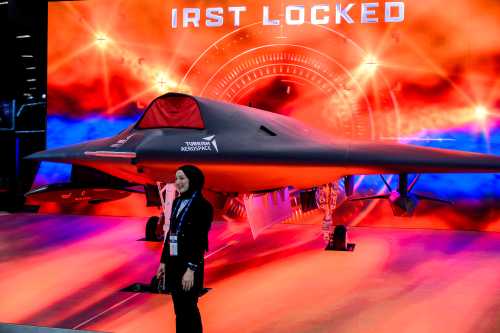
The Turkish defense industry has experienced significant growth over the last decade, driven by effective government policies, competitive products, and substantial investments. Turkish defense companies are becoming increasingly innovative, focusing on creating products for both domestic use and international sales. Nevertheless, Turkey confronts challenges in its defense collaboration with Western allies, particularly the United States. The country aims to navigate or mitigate U.S. export restrictions regarding defense goods, services, and technology.
### Historical Background of the Turkish Defense Industry
Turkey’s experience with U.S. sanctions is not new. The modern Turkish defense sector emerged from an embargo imposed by Congress after Turkey’s 1974 incursion into Cyprus. This embargo catalyzed economic reforms during the Turgut Özal administration, prompting investments in domestic defense companies that now dominate the local market. These initial investments were bolstered by policies encouraging industrial offsets, compelling U.S. defense companies to produce components or manufacture equipment within Turkey. The current push for domestic production continues to advance, although recent U.S. sanctions have further spurred investment in the defense sector.
In response to a de facto embargo in 2019 following its military actions in northern Syria, Turkey intensified efforts to foster a “Made in Turkey” brand. This initiative managed to attract investments in critical technologies aimed at eliminating reliance on U.S. components. While the results have been mixed, notable gains have been made. Turkish leaders attribute declines in defense exports, particularly in attack helicopters, and the struggles of the Baykar TB2 drone’s international sales to U.S. restrictions.
### Potential and Challenges in the European Market
Given the surge in European defense expenditures since the Russian invasion of Ukraine, a question arises about Turkey’s potential to secure contracts in Europe. Though media narratives may suggest optimism, the reality indicates substantial hurdles remain. While Turkey’s artillery shell production is thriving, and its drone technology is gaining traction, the country still faces challenges in shifting from a niche player to a competitive force in the European defense market.
Turkey’s defense situation is complicated by a fragmented and bureaucratic European defense market. Governments predominantly lean on established production consortiums like Airbus or Eurofighter for advanced aerospace needs. These consortiums provide benefits such as comprehensive expertise and redundancy but often face slow decision-making processes and complicated bureaucratic hurdles. Consequently, Turkey must navigate these complexities to break into the advanced aerospace partnerships it seeks.
### The Hürjet Program and Its Implications
The introduction of the Hürjet trainer represents Turkey’s ambitions in the aerospace sector but also highlights its limitations. The agreement with Spain mandates that a significant portion of the work remain within Spanish borders, ensuring local production of avionics and maintenance. This arrangement limits Turkey’s role in long-term support for the platform and emphasizes the challenges it faces in competing with seasoned players in a mature market dominated by established names.
Despite these challenges, the Hürjet program injects crucial funds into the Turkish defense portfolio, potentially lowering costs for local production. Yet the success of this initiative largely hinges on the platform proving its safety and reliability, as it currently lacks a substantial operational track record, placing it at a disadvantage compared to its rivals.
### Future Prospects and Strategic Directions
While the Turkish defense industry has seen considerable advancements, it primarily thrives in low-tech sectors. High-demand products like 155mm artillery shells and the Baykar TB2 drone have carved out a niche in the global market. However, scaling up high-tech exports remains problematic. Ankara’s strategy may shift toward enhancing drone technology, where it holds a competitive edge, rather than venturing into high-tech aerospace markets where it currently faces significant limitations.
In summary, Turkey occupies a unique position within the European defense landscape, combining competitive products that rival major European firms. However, as it aspires to elevate its technological capabilities, the challenges surrounding its defense industrial base persist. Until these issues are resolved, expectations for Turkey to emerge as a significant supplier of advanced defense technologies in Europe will likely remain optimistic but unrealistic in the near term.