
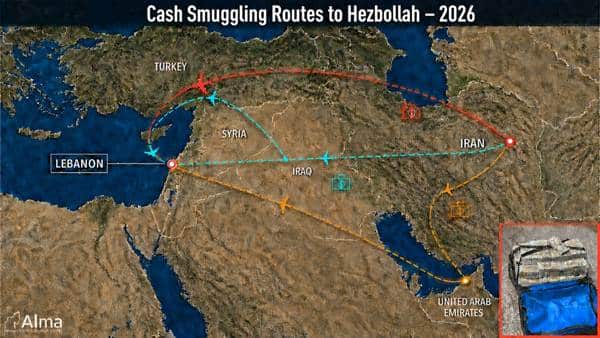
The recent sanctions levied by the U.S. Department of the Treasury have unveiled a complex operation responsible for funneling substantial financial resources to Hezbollah. On August 20, actions were taken against ten individuals linked to this network, which has reportedly moved hundreds of millions of dollars through an intricate web of couriers and financial transactions. The primary purpose of these operations is to obtain foreign currency while evading the constraints imposed by sanctions against Hezbollah.
Historical Context of Cash Transfers to Hezbollah
The method of utilizing cash couriers for transferring funds from Iran to Hezbollah is well-established and has persisted for years. While it appears that the frequency of these operations may have dwindled recently due to heightened scrutiny and specific disruptions in delivery channels, the logistical routes remain accessible. Therefore, while the volume of operations may have decreased, the underlying infrastructure continues to facilitate financial support for Hezbollah.
Key Players in the Smuggling Network
Central to this operation is Turkish businessman Yunus Alper Yilmaz, who orchestrated the movement of funds and provided a façade of legitimacy through Turkey’s currency-exchange systems. He established shell companies and coordinated bank accounts specifically designed to link to Iran’s Quds Force. Alongside Yilmaz, three associates played crucial roles in fund collection and logistical coordination, while six additional couriers transported the cash on various commercial flights to Lebanon.
This incident highlights the strategic importance of Turkey as a hub for Iran’s smuggling operations, especially after the disruption of direct transfer routes through Syria. The diverse routes available—from Iran to Turkey or the UAE and then on to Lebanon—offer flexibility within the courier networks and pose significant challenges for tracking the source and flow of funds.
Local Infrastructure Supporting Transfers
In addition to international routes, local systems within Lebanon play a vital role in facilitating the reception of funds and goods. Recent reports have indicated that individuals like Hussein Ali Nasr, a deputy commander of Hezbollah’s Unit 4400, actively engaged in smuggling operations within Lebanon, often collaborating with Quds Force members. His coordination with airport personnel at Beirut International Airport illustrates how local infrastructures enable and support these illicit activities.
While commercial flights serve as a key component of the network, the entire transfer process also depends significantly on ground-level operations to ensure successful delivery. This multifaceted approach, which includes cash circulation through currency exchanges and informal transfer systems like hawala, creates a decentralized financing structure that is extremely challenging to disrupt.
Implications and Outlook
Despite the disruption of key players within the network, the infrastructure remains robust and operational. The continuous linkages to Quds Force officials and the strategic collaboration with local entities indicate a significant oversight gap. In tandem with international scrutiny, these findings should prompt a reassessment of existing measures aimed at curbing financial support for Hezbollah.
Iranian funding is indispensable for Hezbollah’s various operations, including salary disbursements, military enhancement, and maintaining its political influence among Shiite communities. Consequently, while the revelation of this network serves as a noteworthy milestone, it also underscores an ongoing challenge: as long as operational bases, financial infrastructures, and intermediary facilitators persist, the potential for Iran to replenish its support for Hezbollah remains high.