
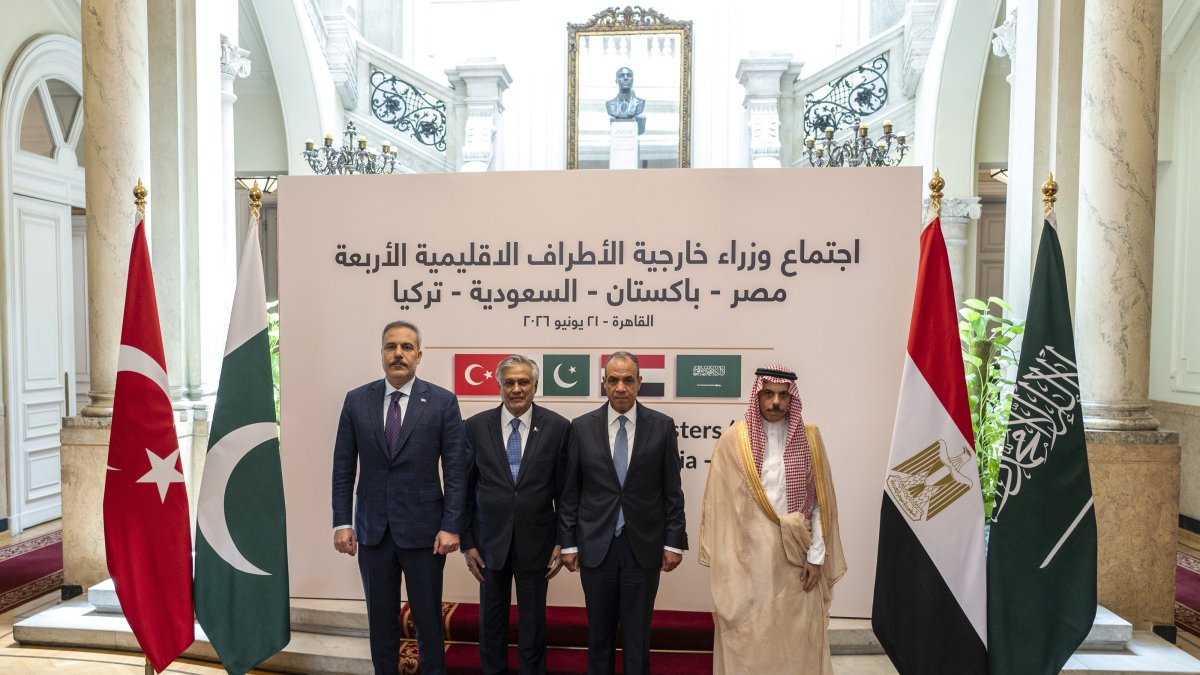
Foreign Minister Hakan Fidan traveled to Cairo for a diplomatic initiative alongside Saudi Arabia’s Foreign Minister Prince Faisal bin Farhan Al Saud and Pakistan’s Foreign Minister Mohammad Ishaq Dar. This meeting, hosted by Egypt’s top diplomat Badr Abdelatty, took place just one day after Fidan’s arrival. The focus was primarily on advancing the implementation of a diplomatic agreement between the United States and Iran, as well as discussing regional developments.
Significant Discussions in Cairo
During the same time frame, U.S. and Iranian officials convened in Switzerland, further highlighting the urgency of diplomatic dialogues. In Cairo, the four ministers concentrated on the framework and future steps necessary for advancing the U.S.-Iran deal. This marked the fourth quadrilateral meeting among these nations, following previous discussions in Riyadh, Islamabad, and Antalya. Each session has centered on the complex dynamics of the U.S.-Israel-Iran conflict and the nuances of cooperation among the four countries.
Fidan’s presence in Cairo also included an audience with Egyptian President Abdel-Fattah el-Sissi, underscoring Türkiye’s influential role in fostering diplomatic channels to mitigate tensions between the U.S. and Iran. The cooperative efforts have gained momentum as both Türkiye and Pakistan have taken the lead in advocating for peaceful resolutions.
Ongoing Negotiations and Challenges
High-stakes discussions also unfolded in the Swiss mountain resort of Bürgenstock, where U.S. Vice President JD Vance met with Iranian representatives. However, these negotiations were overshadowed by reports of escalating violence between Israeli forces and Hezbollah in Lebanon, raising concerns about the overall stability in the region despite the ongoing cease-fire.
Iran’s Foreign Ministry took a cautious stance regarding the anticipated outcomes of the talks. Ministry spokesperson Ismail Baghai remarked that the discussions were not expected to extend beyond a single day and would start with bilateral meetings between Iranian representatives and delegations from Pakistan and Qatar. A subsequent round with the U.S. delegation was planned to follow in the afternoon.
Key Issues on the Agenda
Expert level working groups have been proposed to focus on critical matters like unfreezing Iranian bank accounts and potentially easing sanctions. The provisional cease-fire reached between Washington and Tehran stipulates that a comprehensive agreement on Iran’s nuclear program must be finalized within 60 days. Nevertheless, the tenuous nature of this truce was underscored by Iran’s military, which announced a renewed closure of the Strait of Hormuz to shipping, citing violations of the cease-fire in Lebanon.
Adding further pressure, former President Trump’s repeated threats to impose a U.S.-controlled transit fee in this vital waterway loom large if a deal is not reached within the stipulated timeframe. This combination of diplomatic efforts and rising tensions illustrates the complex and often volatile nature of international relations in the region.
As these multilateral conversations unfold, it remains evident that the road ahead is fraught with both challenges and opportunities, with countries closely watching the negotiations to gauge their long-term implications for regional stability.