
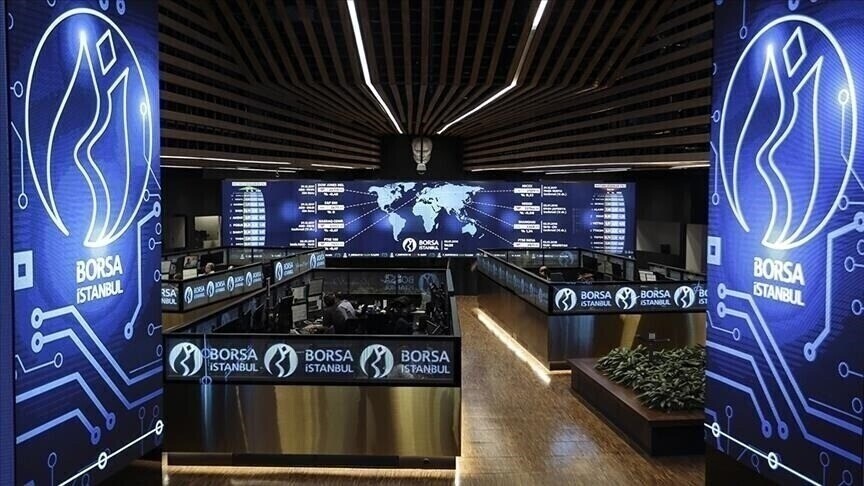
Türkiye’s stock market faced significant turbulence recently, as reflected in the performance of the BIST 100 index. A closer look reveals the shifting dynamics of the market and the factors influencing its trajectory.
Stock Market Overview
On Wednesday, Türkiye’s benchmark BIST 100 index concluded the trading day at 13,122.58 points, representing a decline of 5.54% from its previous close. This significant drop marks a concerning trend for investors. The index opened the day at 13,868.17 points but lost ground throughout trading hours, ultimately falling by 769.72 points from Tuesday’s closing figure.
During the day, the index experienced a low of 12,817.01 points, while touching a high of 13,877.35 points, indicating high volatility. This fluctuation points to the uncertainty enveloping the market, as traders respond to a mix of local and global economic factors.
Market Capitalization and Trading Volume
The overall market capitalization of the BIST 100 stood at approximately 12.77 trillion Turkish liras, equivalent to about $263.02 billion. Daily trading volume was recorded at 262.4 billion Turkish liras, or $5.39 billion. This volume demonstrates significant trading activity, despite the downward pressure on stock prices. The stark contrast between the high trading volume and the loss in index value emphasizes the prevailing uncertainty among investors.
Out of the stocks represented in the index, a majority of 95 saw declines, while only five managed to rise compared to the prior close. Such trends often reflect overall market sentiment and can indicate broader economic concerns that traders are considering.
Commodity Prices and Currency Exchange Rates
In addition to stock market performance, other economic indicators have come into play. As of 6:20 PM local time, the price for an ounce of gold was $4,350.85, showcasing ongoing investment interest in precious metals amidst market turbulence. Meanwhile, Brent crude oil futures were trading around $104.85 per barrel, illustrating fluctuations in global energy prices, which can also impact local markets.
Currency exchange rates are another critical component to analyze. The US dollar to Turkish lira exchange rate was listed at 48.6577, while the euro traded at 56.1850 liras and the British pound at 65.5210 liras. These figures highlight the impact of the global economy on Türkiye’s financial landscape, particularly as currency valuation can influence trade and investment flows.
In summary, the recent performance of Türkiye’s stock market reflects a complex interaction of local and international economic factors. While the BIST 100 index faced notable challenges, the vibrant trading volume and fluctuations in commodity and currency prices suggest an ongoing debate among investors about the market’s future direction. For those watching the Türk financial landscape, staying informed on these developments will be crucial in navigating the uncertainties ahead.