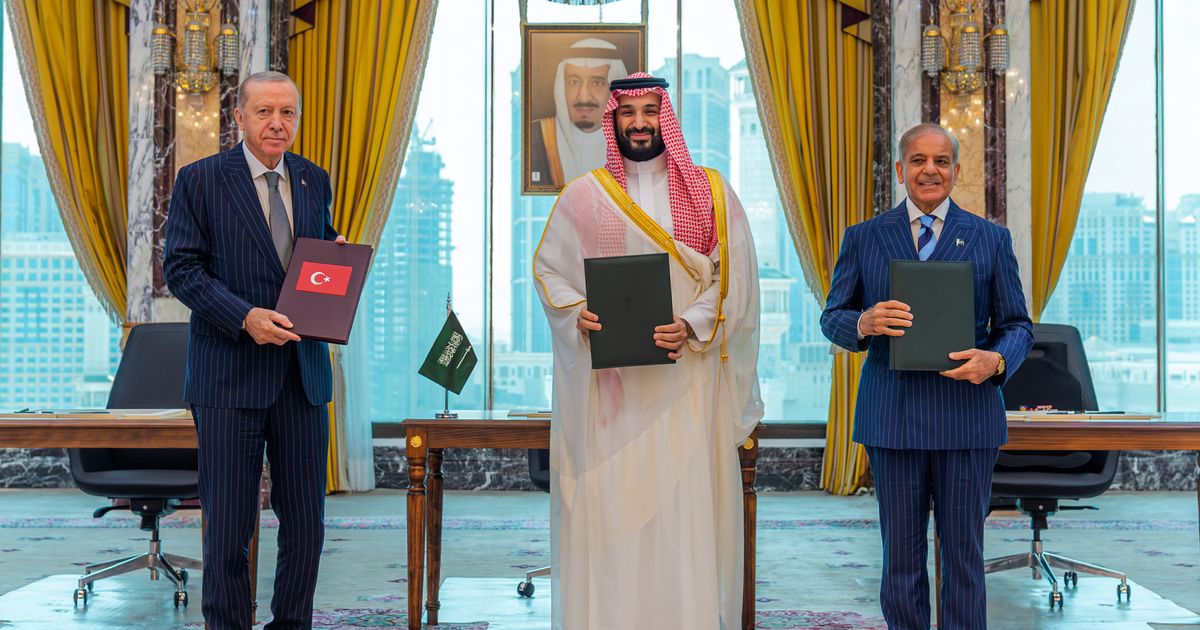
Turkey’s government has initiated a request for parliamentary approval of a mutual defense agreement with Saudi Arabia and Pakistan, aiming to enhance Saudi Arabia’s protective measures amidst ongoing threats from Iran-backed Houthi rebels. This development marks a significant step in Turkey’s defense policy, aligning with shared regional security concerns.
The Mecca Joint Defense Agreement Explained
The so-called Mecca Joint Defense Agreement, signed in August by Saudi Crown Prince Mohammed bin Salman, Turkish President Recep Tayyip Erdogan, and Pakistani Prime Minister Shehbaz Sharif, resembles NATO’s Article 5. Under this pact, an armed attack on one nation is considered an attack on all three partners. While Turkey is contemplating military support for Saudi Arabia, officials clarify that their involvement is strictly defensive and does not entail deploying troops for combat in Yemen against the Houthis.
Turkish and Pakistani officials have emphasized that the agreement is not a provocative stance against Iran or other countries but have remained noncommittal regarding potential retaliatory actions in case of an attack by Iran. This reflects a careful balance of regional diplomacy, aiming to deter threats without escalating tensions.
Strengthening Regional Security Dynamics
The Mecca Agreement strategically combines the military capabilities of Saudi Arabia, Pakistan, and Turkey, fostering enhanced cooperation in a volatile geopolitical landscape exacerbated by increasing regional conflicts. The three nations are positioning themselves to assume greater responsibility for their security in light of diminished U.S. involvement in the region, signaling a shift towards self-reliance among regional powers.
For Pakistan, this agreement builds on its existing military affiliations with Saudi Arabia, which have included a separate mutual defense pact established in September 2025. As per Pakistani Foreign Minister Ishaq Dar, the new agreement does not replace prior arrangements but remains open to other nations interested in contributing to its principles of collective security and peaceful conflict resolution.
Commitment and Implementation Details
Although the specifics of military support are still under consideration, prior discussions have highlighted areas of potential assistance including air defense systems and electronic warfare capabilities. Turkish Foreign Minister Hakan Fidan has reassured the public that Turkey’s role will not involve offensive military actions, prioritizing a defensive posture aimed at safeguarding regional stability.
This arrangement implies a substantial commitment over a decade, as outlined in a 16-article framework that mandates military collaboration in instances of external aggression. Key elements of the agreement focus on military training, potential joint arms production, and intelligence sharing, enhancing defense readiness among the three nations. Notably, a clause stipulates that parties cannot withdraw from the pact for at least ten years, reflecting a long-term commitment to collective security.
Pakistan’s Strategic Role and Future Meetings
While Pakistan has not sought parliamentary approval for the Mecca agreement, its military leadership remains committed to offering support for Saudi defense strategies. With decades of experience in counter-terrorism operations, Pakistan’s military forces are well-positioned to enhance Saudi Arabian military capabilities.
The strategic infrastructure of the agreement also includes the establishment of a Strategic Political and Defense Committee, responsible for overseeing collaborative efforts and reconvening biannually. Retired Pakistani General Nauman Mahmood has been appointed as the first secretary-general of this committee, tasked with driving the objectives of the pact and ensuring cohesive coordination among member states.
In conclusion, the Mecca Joint Defense Agreement represents a pivotal shift in security dynamics within the region, offering a framework for collaborative defense and regional stability in an increasingly complex geopolitical landscape.