
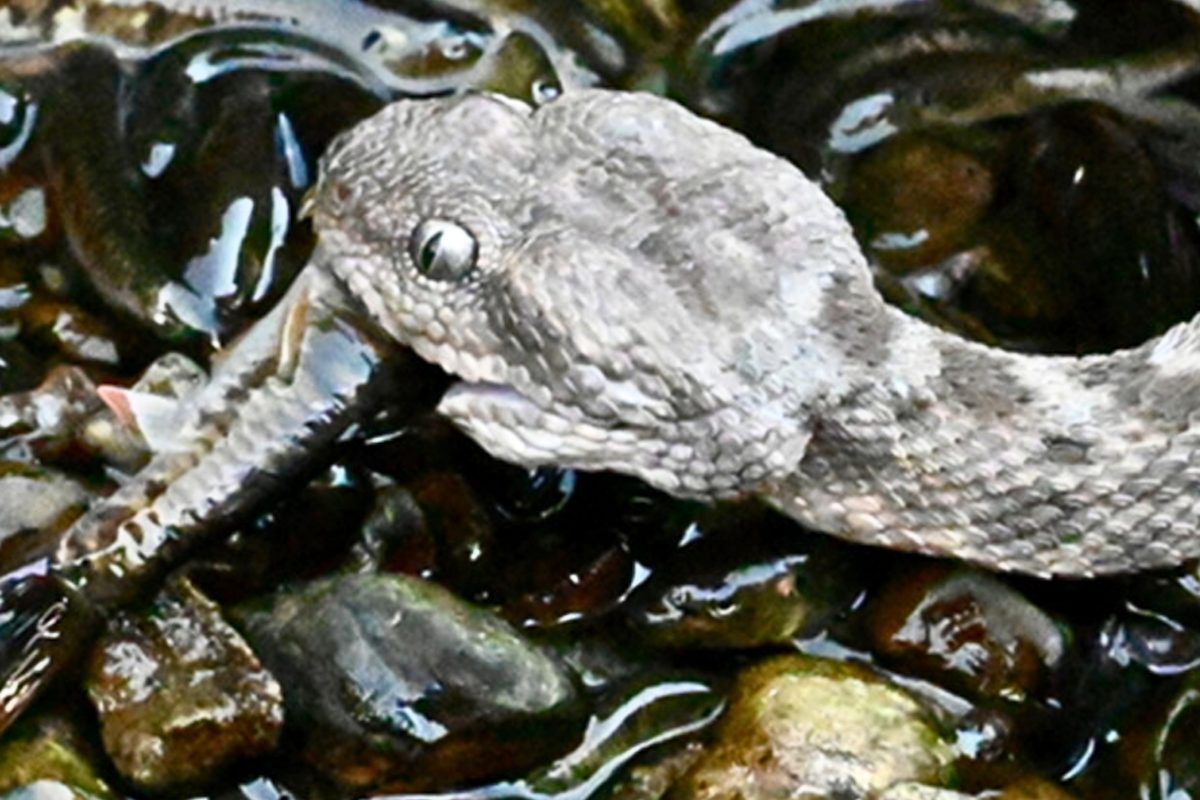
For the first time, researchers have documented a unique case of snake behavior in the arid climates of the Arabian Peninsula. The Oman saw-scaled viper, normally known for its diet of small mammals and reptiles, has been observed feeding on fish in the United Arab Emirates. This intriguing finding highlights the adaptability of this species in response to changing environmental conditions.
Unusual Feeding Behavior of the Oman Saw-Scaled Viper
The Oman saw-scaled viper, scientifically known as Echis omanensis, typically preys on lizards, rodents, and amphibians. However, recent observations revealed two individual snakes actively hunting and consuming Garra barreimiae, a small freshwater fish. These groundbreaking sightings were recorded by researchers in the UAE and have been detailed in the journal Ecology and Evolution, where they also reviewed the phenomenon of fish-eating vipers.
The lead author of the study, Theo Busschau from New York University Abu Dhabi, noted the significance of snake diets in understanding ecological dynamics and evolutionary changes. “Among vipers, feeding ecology has played a crucial role in the evolution of fang and skull morphology,” he remarked. This adaptation allows these venomous snakes to thrive in diverse habitats, showcasing their evolutionary flexibility.
Understanding the Habitat and Ecology of Saw-Scaled Vipers
Saw-scaled vipers belong to the Echis genus, prevalent in Northern Africa and parts of Western and Southern Asia. This family comprises 12 species, ranging from 30 to 90 centimeters in length, distinguished by the serrated edges of their scales. When threatened, these vipers can produce a crackling sound by rubbing their scales together. They typically inhabit deserts, savannas, and arid scrublands, where their diet is greatly influenced by prey availability.
The study indicates that the diet of these snakes may be shaped by the most accessible prey in their environment. The report elaborates, “Factors influencing diet remain unclear, but it is plausible that dietary adaptations, and therefore venom evolution, are dictated by the abundance of suitably sized prey within specific habitats.”
First Observations of Fish Consumption
The fish-feeding observations occurred in mountainous areas of Northern Oman and the UAE, with two notable instances recorded. The first observation in May 2023 took place next to a drying river, or wadi, where the viper was spotted with a fish already in its mouth. In the second instance, observed in June 2025, another viper was seen approaching and capturing a garra fish in similar conditions.
These behaviors point to intriguing ecological dynamics, particularly surrounding the spawning patterns of garra, which lay eggs in anticipation of floods. When the floodwaters recede, temporary pools often trap fish, providing a potential food source for local predators like the Oman saw-scaled viper. The findings suggest that these snakes are capable of identifying these pools as opportunistic hunting grounds.
Research on snake feeding behavior remains limited, and such observations are rare. The study’s conclusion emphasizes the need for documenting natural history, even aspects presumed to be well understood. “We stress the importance of sharing natural history observations on citizen science platforms to enhance our knowledge,” the report states.
In summary, the documented instances of the Oman saw-scaled viper consuming fish underline the species’ adaptability to varying ecological conditions. Researchers encourage ongoing exploration and sharing of such rare observations to deepen our understanding of wildlife behavior in distinct habitats.