
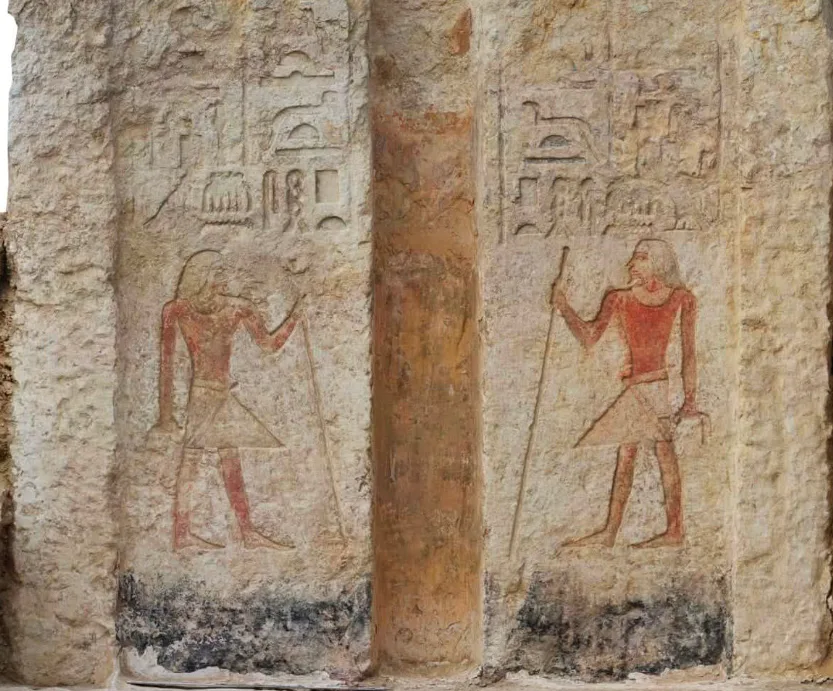
Archaeological excavations in the Bubasteion necropolis at Saqqara have unveiled a remarkably preserved tomb from Egypt’s Old Kingdom. This burial site belonged to Sekhentiu-Ptah, a high-ranking official known for his significant roles in the royal court. Such discoveries offer invaluable insights into ancient Egyptian practices and beliefs.
Tomb Structure and Significance
The newly discovered tomb features a funerary chapel and a false door that displays the titles held by Sekhentiu-Ptah. His prominent positions included Royal Chamberlain, Overseer of All the King’s Affairs, and Keeper of the Secrets of Royal Decrees. These titles underline his importance during an era when royal favor dictated social standing and influence. The tomb not only serves as a resting place for this high official but also stands as a testament to the architectural prowess and complexity of burial sites from that historical period.
Ritual Offerings and Artifacts
A significant aspect of the tomb is the intact collection of ritual alabaster objects. Among these items are a table, an offering slab, and a purification bowl, all remaining in their original positions. This preservation offers researchers a unique glimpse into the ceremonial practices of the time. According to Hisham El-Leithy of Egypt’s Supreme Council of Antiquities, the arrangement of these objects will enhance our understanding of Old Kingdom funerary rites, which date back approximately between 2649 and 2150 BC.
What Lies Beneath: Additional Finds
Adjacent to Sekhentiu-Ptah’s tomb, archaeologists delved into a network of interconnected burial shafts. During their exploration, they uncovered human remains, three sealed stone sarcophagi, a wooden falcon statue, pottery, painted funerary cartonnage, and over 100 faience ushabti figurines. These findings enrich our understanding of the burial customs and material culture of the Old Kingdom. However, some burial shafts have shown signs of looting in antiquity, indicating that not all historical remnants have been preserved as well as Sekhentiu-Ptah’s resting place.
The Value of Intact Discoveries
The exceptional condition of Sekhentiu-Ptah’s tomb, along with its artifacts, is particularly significant for scholars interested in ancient Egyptian funerary practices. While many tombs have been damaged or pillaged over centuries, this site offers an unprecedented opportunity to study the cultural aspects associated with death and afterlife beliefs during the Old Kingdom. Researchers hope that further analysis will reveal essential information about social hierarchies, customs, and the spiritual beliefs of ancient Egyptians.
As archaeology continues to shed light on the rich history of ancient Egypt, findings like those from the Bubasteion necropolis remind us of the sophisticated civilization that once thrived along the Nile. Each discovery brings us closer to understanding the complexities of past societies, enriching our knowledge of human history. Researchers eagerly anticipate future revelations as excavations in this fertile archaeological ground continue.