
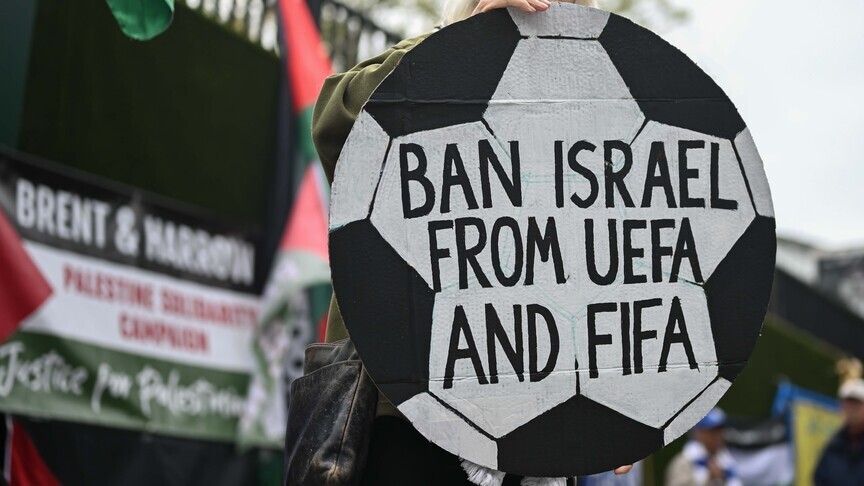
Amnesty International has recently urged both UEFA and FIFA to suspend Israel’s football association, claiming that its participation in the Nations League is unacceptable due to its ties to clubs in illegal settlements. The organization emphasizes the moral implications of allowing the Israeli men’s football team to compete while supporting activities that disregard international law and human rights.
Call for Action from International Bodies
Amnesty International’s regional director for Europe, Steve Cockburn, expressed deep concern over the ongoing participation of Israel’s football association in international competitions. In a statement, Cockburn highlighted that it is “unconscionable” for the Israeli team to compete in the UEFA Nations League, given the evident support for clubs based in settlements deemed illegal by international standards. He reiterated that UEFA and FIFA must act by suspending the Israel Football Association (IFA) until it distances itself from these clubs.
The Legal and Ethical Implications
According to Amnesty, the involvement of settlement-based clubs in Israeli leagues not only contravenes FIFA statutes but also violates international law. Cockburn further noted that UEFA and FIFA’s financing of the IFA risks perpetuating Israel’s illegal occupation and its associated violations. The ethical concerns surrounding the inclusion of Israel in international football are growing, particularly as the teams start to compete in Group B3 of League B alongside Austria, the Republic of Ireland, and Kosovo.
Growing Opposition to Israeli Participation
In Ireland, an increasing number of voices—including football associations, players, activists, trade unions, and politicians—have begun to call for sanctions against Israel, citing moral imperatives. The Football Association of Ireland has also formally requested UEFA to reconsider Israel’s eligibility in the league. This collective sentiment reflects a wider movement opposing the use of sports as a platform for nations engaging in human rights violations.
A Broader Perspective on Sports and Justice
Cockburn underscored the notion that sports should not serve as a façade for states involved in criminal activities. While the Israeli team prepares for its matches, Palestinian families suffer grave injustices, including displacement and land confiscation supported by the Israeli military. The implications of football extend beyond the pitch; they reflect deeper social issues, with the potential to either unite communities or perpetuate systemic inequality. “The beautiful game should bring people together, not rubber-stamp apartheid,” Cockburn stated, framing the conversation within the larger context of human rights.
As the situation unfolds, Amnesty International has persistently communicated with FIFA and UEFA, urging that the IFA be suspended unless it dissociates from clubs based in occupied territories. However, FIFA’s decision in March 2026 to take no action against the IFA has intensified further calls for accountability. This has prompted the Palestinian Football Association to escalate the matter to the Court of Arbitration for Sport. The ongoing discussions reveal a complex interplay of sports, politics, and human rights, raising critical questions about the responsibilities of international sports organizations in addressing ethical concerns.