
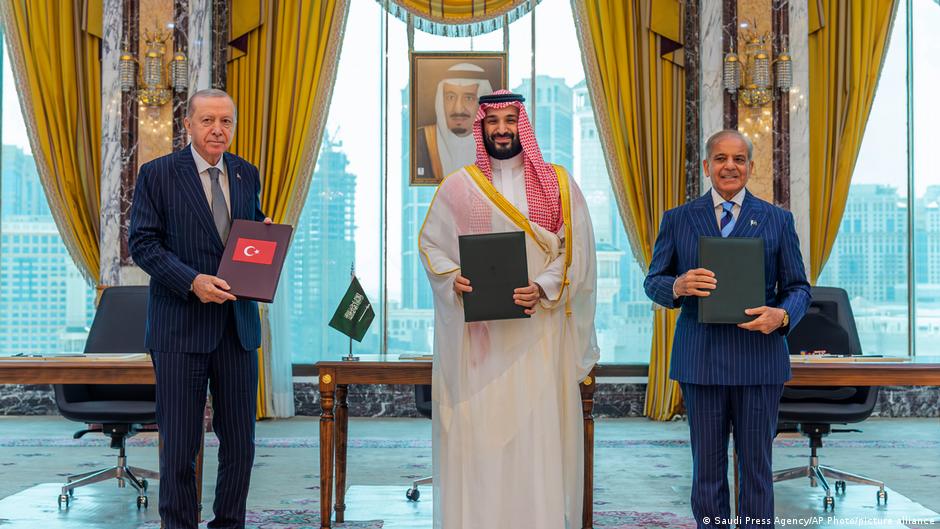
The recent “Mecca Joint Defense Agreement,” established between Saudi Arabia, Turkey, and Pakistan on August 7, emerges against the backdrop of heightened tensions in the Middle East, particularly regarding Iran. As regional dynamics shift, this pact carries significant implications for security alliances in the area.
Context of the Alliance
Saudi Arabia has been actively pursuing new security partnerships due to concerns about the reliability of the United States’ traditional protective role. Meanwhile, Turkey seeks to assert more influence in the region, and Pakistan aims to leverage its long-standing military ties with Riyadh into a broader strategic standing. This agreement underscores a collective defense commitment: any armed attack against one member is viewed as an assault on all three nations.
Furthermore, this pact reinforces existing relationships. Historically, Pakistan has provided training support to Saudi forces for decades, and military cooperation with Turkey has intensified through various exchanges and collaborative efforts. For India, the main concern revolves around whether this pact empowers Pakistan, its longstanding rival, in a region where India’s interests are growing considerably.
Implications for India
While some Indian analysts perceive minimal immediate impact on the regional balance, others caution that this agreement could signal a need for India to enhance its own security posture in the Gulf. Given that Saudi Arabia is a significant energy and investment ally for India, the geopolitical aspect of this trilateral agreement is crucial for New Delhi. The Gulf and the Red Sea are pivotal for India’s trade and energy security, and any shifts in military alliances could have long-term repercussions.
The pact potentially enables Pakistan to expand its influence in the Gulf region and could provide a structured framework for heightened defense collaboration, complete with improved access to funding and technology. However, certain analysts, including former Indian High Commissioner to Pakistan, Ajay Bisaria, argue that the agreement lacks substance and will not significantly alter India-Pakistan dynamics. Bisaria asserts that while the pact may appear significant, it is unlikely to lead to a fundamental shift in Saudi Arabia’s stance in the event of an India-Pakistan crisis.
Considerations for India’s Strategy
Tara Kartha, a former member of the National Security Council Secretariat, emphasizes that India should not overreact to the Mecca pact, as Saudi Arabia and Turkey do not perceive India as a strategic adversary. Many elements of the Pakistan-Turkey military relationship are already established, suggesting that the new agreement may provide primarily increased funding for Pakistan’s defense budget rather than a significant change in military capabilities.
Nonetheless, the prospect of enhanced military resources from Turkey to Pakistan raises questions for India regarding its immediate security strategy. India’s ties with Saudi Arabia, which are deeply rooted in energy, trade, and political cooperation, have cultivated an environment where Riyadh’s efforts to broaden security alliances do not necessarily place Pakistan in a favorable position over India.
Geopolitical analysts recommend that India should respond strategically yet cautiously to this development. By fostering deeper bilateral relations with Saudi Arabia, India could potentially mitigate the risks of Pakistan gaining disproportionate influence in the region while continuing to monitor military advancements that may emerge from the trilateral agreement.
Conclusion: A Wake-Up Call for India?
The Mecca pact serves as a critical reminder for India concerning its security strategies in the Gulf. India’s increasing economic dependence on the region must be accompanied by a robust military presence. Experts advocate for bolstering defense and intelligence cooperation with Saudi Arabia and other Gulf nations.
As the balance of power continues to evolve, New Delhi must recognize the necessity of a more significant military footprint to align its economic interests with security realities. The agreement represents an effort by Saudi Arabia to diversify its alliances, but India’s response must also include an enhanced military engagement strategy to ensure its national interests are protected amid changing geopolitical landscapes.