
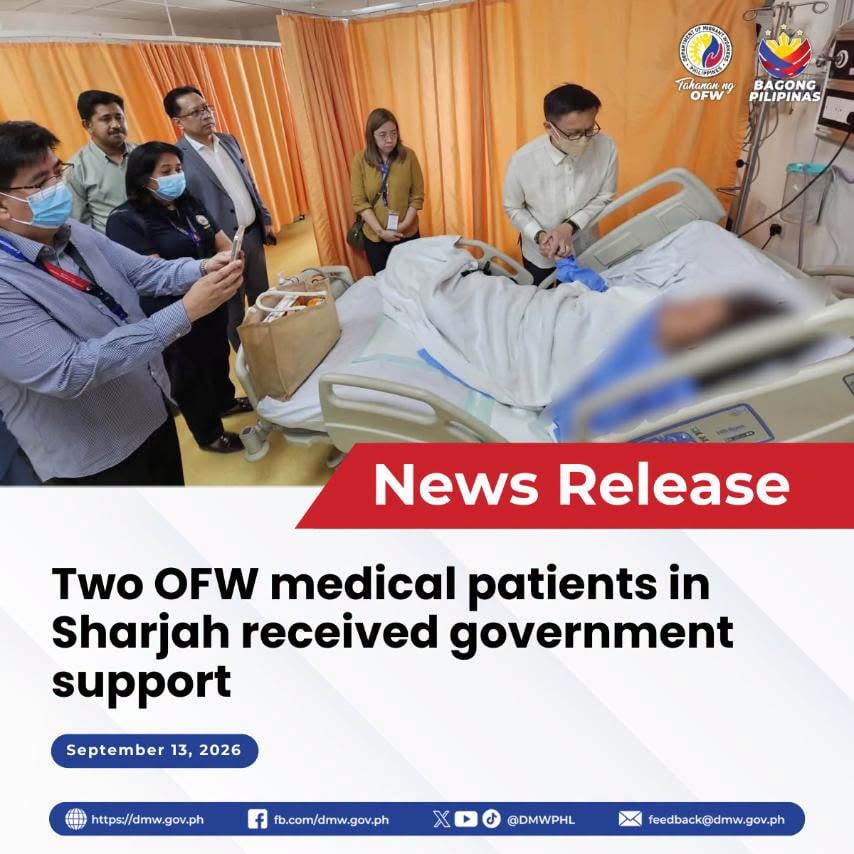
Two overseas Filipino workers (OFWs) who experienced strokes while in the United Arab Emirates are receiving critical support as they prepare to leave the hospital. The Department of Migrant Workers (DMW) and the Overseas Workers Welfare Administration (OWWA) are assisting their recovery with post-acute care services.
Hospital Visit by Migrant Workers Secretary
On September 10, Migrant Workers Secretary Hans Leo Cacdac visited the two recovering OFWs at Al Qassimi Hospital in Sharjah. During this visit, he confirmed that the government is organizing necessary support for their transition from hospital care to home recovery. “During my visit to Sharjah’s Al Qassimi Hospital, I met with the two stroke patients who are now fit for release, as we prepare post-acute care through DMW-OWWA. One of our patients is from Lubao, Pampanga, and we will coordinate with Governor Nanay Pineda and our OFW Hospital for additional treatment,” Cacdac stated. His remarks reflect the ongoing commitment of the government to provide continuous care for its citizens abroad.
Gratitude for Healthcare Providers
Cacdac expressed his appreciation for the medical staff at Al Qassimi Hospital, emphasizing the vital role of Filipino nurses and healthcare workers in aiding patients’ recovery. His gratitude underscores the collaborative efforts within the healthcare system to support overseas workers during challenging times. The dedication of these professionals significantly contributes to the well-being of OFWs in the UAE.
Safety Measures for Seafarers
In light of recent maritime incidents, Cacdac has also emphasized the urgent need for shipowners to bolster safety protocols for Filipino seafarers operating in high-risk areas. This call to action came shortly after a tragic projectile attack on the crude oil tanker M/V SIDR on August 31, which resulted in the deaths of two Filipino crew members and necessitated the repatriation of 14 survivors. Cacdac highlighted that shipowners must respect seafarers’ internationally recognized rights, which include the ability to decline assignments in dangerous waters. “It is paramount to strengthen protections for those who choose to continue their duties in these challenging environments,” he asserted.
Cacdac also advised shipowners to keep crew members out of vulnerable spaces, such as engine rooms, during crossings through high-risk zones. He referenced previous attacks in which seafarers stationed in these areas were targeted and lost their lives. “We need to enhance safety measures onboard, especially when a vessel plans to navigate through a perilous region,” he stated confidently.
Support and Repatriation Efforts
The 14 Filipino crew members from the M/V SIDR were successfully repatriated to the Philippines, thanks to the collaborative efforts of the governments of the UAE and Oman. Cacdac expressed his gratitude to both nations for their assistance in ensuring the safe return of the seafarers. This incident underlines the shared responsibility in providing protection and support for Filipino workers abroad, particularly in high-risk occupations.
As the government continues to focus on the well-being of overseas workers, the initiatives aimed at improving healthcare and safety protocols are critical steps in safeguarding the lives and livelihoods of Filipinos working overseas.