
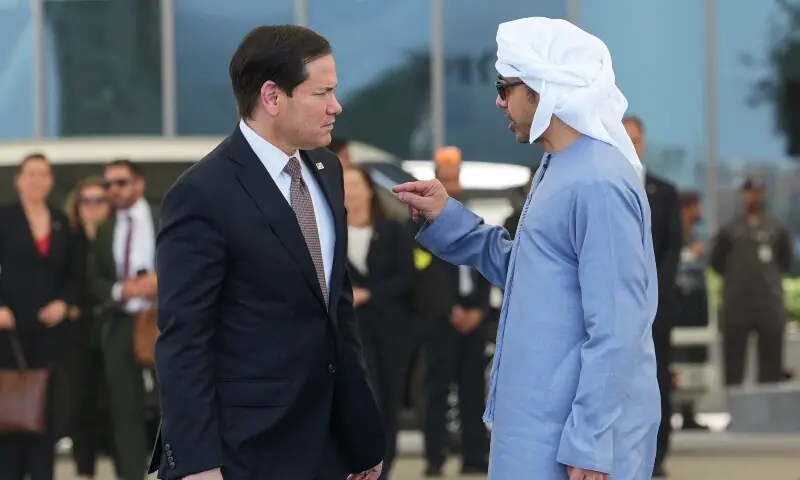
US Secretary of State Marco Rubio recently engaged in discussions with UAE President Mohamed bin Zayed regarding the US-Iran agreement, reaffirming Washington’s dedication to the security of its Gulf allies. This conversation comes amidst Rubio’s tour of the region, emphasizing the US commitment to support nations that have experienced Iranian aggression.
Addressing Regional Concerns
Rubio’s discussions aimed to alleviate the worries of US allies impacted by Iranian missiles during ongoing conflicts in the Middle East. The memorandum of understanding (MoU) with Tehran has drawn criticism for not addressing longstanding issues, particularly concerning Iran’s missile program. Iran has claimed that it has targeted US assets in Gulf states while neglecting to take responsibility for numerous attacks. This backdrop poses a complex challenge for Rubio as he attempts to reassure allies who experienced the fallout of this aggression.
Rubio’s spokesperson, Tommy Pigott, noted that the meeting covered critical topics including efforts to ensure secure navigation through the Strait of Hormuz and the importance of regional peace and stability. During the dialogue, Rubio expressed gratitude for UAE leadership, acknowledging its bravery in facing threats from Iran, and reaffirmed the US’s unwavering commitment to Emirati security.
Upcoming Discussions and Future Challenges
Rubio’s itinerary included closed meetings with UAE officials, including National Security Adviser Sheikh Tahnoun bin Zayed Al Nahyan. His mission extends beyond addressing immediate concerns, as he plans to discuss aspects of the MoU neglected during previous negotiations. It remains crucial for Rubio to navigate the sensitive dynamics of Gulf relations in light of heightened anxieties about the accord.
Complicating matters is the ongoing presence of Vice President JD Vance, who conducted discussions regarding Iran in recent weeks. This leadership structure introduces additional layers to the exchange, as negotiations continue to evolve.
The UAE is currently facing substantial economic challenges, spurred by the conflict that forced expatriates—integral to the nation’s non-oil economy—to reconsider their presence in the region. Rubio’s messages during his visit will be under immense scrutiny, as he must balance the administration’s stance on the agreement while addressing the hesitations expressed by Gulf states.
Key Takeaways from the US-Iran Accord
Last week, the US and Iran put pen to paper on a 14-point MoU aimed at outlining broad agreements to conclude hostilities. This interim accord sets the stage for a 60-day window of negotiation aimed at resolving complex issues tied to Iran’s nuclear ambitions. A central concern remains Iran’s highly enriched uranium, with questions surrounding its potential military applications.
Despite efforts for peace, many Gulf leaders found the MoU’s terms surprising and disappointing. There are significant concerns regarding how Iran could leverage the proposed $300 billion reconstruction fund to enhance its military capabilities, especially since the terms do not adequately address Iran’s ballistic missile program.
As this diplomatic landscape evolves, the focus remains on the international implications of the US-Iran agreement, with the safety and stability of Gulf states hanging in the balance. The ongoing dialogue will be critical in defining not only the future of regional geopolitics but also the effectiveness of international treaties aimed at curbing nuclear threats.