
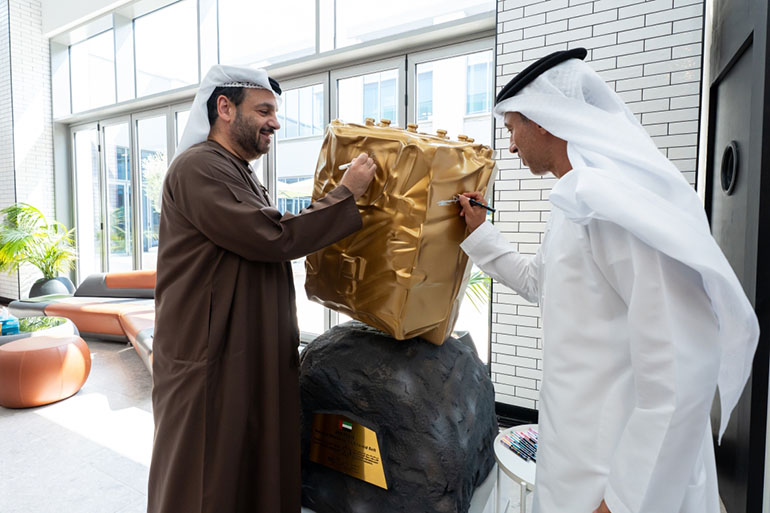
The United Arab Emirates is set to make a significant leap in space exploration with its groundbreaking Emirates Mission to the Asteroid Belt (EMA). Spearheaded by the Technology Innovation Institute (TII), this ambitious project involves launching a deployable probe designed to crash into an asteroid for scientific research.
Overview of the Emirates Mission to the Asteroid Belt
The EMA project aims to send a spacecraft, known as the MBR Explorer, to the asteroid belt. Scheduled for launch in March 2028 from Japan, this mission will represent the UAE’s first foray into deep-space exploration. The MBR Explorer will survey various asteroids while collecting valuable data that could enhance our understanding of the early solar system.
The mission’s standout feature is its innovative deployable probe, which has been specifically engineered to impact an asteroid. By crashing into the target, scientists hope to obtain unique samples that will provide insights into the materials that comprise asteroids. This approach is different from traditional methods of observation; it prioritizes direct interaction with asteroidal materials to yield valuable scientific results.
Technological Innovations Behind the Probe
One of the most intriguing aspects of the probe is its advanced technology. Developed by experts at TII, the probe is equipped with state-of-the-art instruments that enable it to analyze asteroid materials upon impact. By deploying this probe, the mission aims to gather crucial scientific data that could deepen our understanding of the origins of the universe.
The design of the probe emphasizes research efficiency and effectiveness. Once launched, it will travel alongside the MBR Explorer for an extended period, allowing for real-time data transmission before it detaches and makes its descent toward the chosen asteroid. The data collected will be pivotal for assessing the material composition and other significant characteristics of asteroids, potentially unlocking secrets about the solar system’s formation.
Future Implications of Asteroid Research
Studying asteroids can provide more than just academic insights; it could have practical applications as well. The information gleaned from the probe’s findings may influence future space missions, including planetary defense strategies, resource utilization, and even the potential for human colonization of other celestial bodies.
Moreover, this mission aligns with the UAE’s broader vision for space exploration and innovation. As the nation invests in technology and research, the findings from the EMA mission could position it as a pioneering leader in the global space community. The UAE is on the verge of establishing a robust framework for future missions, which may include manned expeditions or further robotic explorations.
In summary, the Emirates Mission to the Asteroid Belt will not only contribute to our understanding of asteroids but also bolster the UAE’s status in the field of space exploration. As we eagerly anticipate the launch of the MBR Explorer in 2028, the implications of this mission may reverberate throughout various scientific disciplines for years to come.